The Know-Nothing Campaign Against Higher Learning
The second Trump administration has committed itself to upending the knowledge systems and deliberative institutions that have been essential to modern democracy, with the American university — site of scientific research and liberal education — a primary target. In The Know-Nothing Campaign Against Higher Learning, literary and film critic James Chandler spotlights an American tradition of such hostility to intellectual life, especially the nativist movement of the 1850s that persecuted Catholic immigrants from Ireland and Germany. Ironically, Steve Bannon, the self-proclaimed “Know-Nothing vulgarian” who long ago recruited candidate Trump to his anti-intellectual crusade, is himself the great-grandson of an Irish immigrant who would have faced Know-Nothing backlash in that era.
Such dark ironies define our moment, Chandler argues, and they call out not only for intellectual critique but also for satire. Yet in the midst of the MAGA campaign’s calamitous effects on American public discourse, even satire must confront the “kayfabe” practices imported by Trump from professional wrestling, which mix illusion and reality to turn political life into a “spectacle without thought.” Drawing widely on cultural critics from Jonathan Swift and Alexis de Tocqueville to Roland Barthes, Chandler’s pamphlet offers an elegant and bracing account of the MAGA campaign against higher learning and its transformative effects on criticism and democracy itself.
Grievance: In Fragments
Grievance is an American mode of being that can be traced back to the Declaration of Independence, that is at the root of the Civil War and accounts in large measure for the failure of Reconstruction, that runs through the Civil Rights moment, and that showed itself again in the events of January 6, 2021. Grievance, in America, always concatenates to racism and evinces itself most violently in those moments when white supremacy, fallaciously, presents itself as being under attack. This book explores this elemental yet destructive thread of the American character.
Pacification and its Discontents
As George W. Bush’s Iraq mission unravelled, U.S. policy elites revived counterinsurgency doctrines—known in an earlier incarnation as pacification. The new edition of the Counterinsurgency Field Manual defines pacification as “the process by which the government assert[s] its influence and control in an area beset by insurgents,” which includes “local security efforts, programs to distribute food and medical supplies, and lasting reforms (like land redistribution).” Such language may sound innocuous, but for Kurt Jacobsen and fellow skeptics, “pacification” and its synonym, “counterinsurgency,” are stale euphemisms for violent suppression of popular resistance movements abroad, citing the inexorable tragic atrocities committed against non-combatants in Vietnam and elsewhere. In this pamphlet, Jacobsen examines pacification, the rehabilitation of repressive practices, and their attendant illusions—practices that, he argues, civilized nations have a duty to abandon.
The Counter-Counterinsurgency Manual | Or, Notes on Demilitarizing American Society
With Contributions by Catherine Besteman, Andrew Bickford, Greg Feldman, Roberto J. González, Hugh Gusterson, Kanhong Lin, Catherine Lutz, David Price, and David Vine.
At a moment when the U.S. military decided it needed cultural expertise as much as smart bombs to prevail in Iraq and Afghanistan, the Pentagon’s Counterinsurgency Field Manual offered a blueprint for mobilizing anthropologists for war. The Counter-Counterinsurgency Manual critiques that strategy and offers a blueprint for resistance. Written by the founders of the Network of Concerned Anthropologists, the Counter-Counterinsurgency Manual explores the ethical and intellectual conflicts of the Pentagon’s Human Terrain System; argues that there are flaws in the Counterinsurgency Field Manual (ranging from plagiarism to a misunderstanding of anthropology); probes the increasing militarization of academic knowledge since World War II; identifies the next frontiers for the Pentagon’s culture warriors; and suggests strategies for resisting the deformation and exploitation of anthropological knowledge by the military. This is compulsory reading for anyone concerned that the human sciences are losing their way in an age of empire.
American Counterinsurgency | Human Science and the Human Terrain
Politicians, pundits, and Pentagon officials are singing the praises of a kinder, gentler American counterinsurgency. Some claim that counterinsurgency is so sophisticated and effective that it is the “graduate level of war.” Private military contracting firms have jumped on the bandwagon, and many have begun employing anthropologists, political scientists, psychologists, and sociologists to help meet the Department of Defense’s new demand. The $60 million Human Terrain System (HTS), an intelligence gathering program that embeds social scientists with combat brigades in Iraq and Afghanistan, dramatically illustrates the approach. But when the military, transnational corporations, and the human sciences become obsessed with controlling the “human terrain”—the civilian populations of Iraq and Afghanistan—what are the consequences? In this timely pamphlet, Roberto González offers a searing critique of HTS, showing how the history of anthropology can be used to illuminate the problems of turning “culture” into a military tool.

Neomedievalism, Neoconservatism, and the War on Terror
President Bush was roundly criticized for likening America’s antiterrorism measures to a “crusade” in 2001. Far from just a gaffe, however, such medievalism has become a dominant paradigm for comprehending the identity and motivations of America’s perceived enemy in the war on terror. Yet as Bruce Holsinger argues here, this cloying post-9/11 rhetoric has served to obscure the more intricate ideological machinations of neomedievalism, the global idiom of the non-state actor: non-governmental organizations, transnational corporate militias, and terrorist organizations such as al Qaeda.
Neomedievalism, Neoconservatism, and the War on Terror addresses the role of neomedievalism in contemporary politics. While international-relations theorists promote neomedievalism as a model for understanding emergent modes of global sovereignty, neoconservatives exploit its conceptual slipperiness for their own tactical ends. Holsinger concludes with a careful parsing of the Bush administration’s torture memos, which enlist neomedievalism’s model of feudal sovereignty on behalf of the abrogation of human rights.
The American Game | Capitalism, Decolonization, World Domination, and Baseball
It is easy to mistake the United States for an empire. But as John D. Kelly explains here, the American approach to global relations is best understood as a competition—one in which the United States, through the reshaping of economic theory and the global economy itself, imposes its own rules on a game played to win. How and where the United States implements these rules can be tracked through complexities in diplomacy and business. But Kelly here cleverly uses the quintessential American game of baseball to show how the United States maintains and advances its dominance over other nations. A thought-provoking read, The American Game could well revolutionize our understanding of the United States’ influence on global politics and economics.
Phantom Calls | Race and the Globalization of the NBA
In the twenty-first century, the idea of race in sports is rapidly changing. The National Basketball Association, for instance, was recently home to a new kind of racial conflict. After a recent playoff loss, Houston head coach Jeff Van Gundy alleged that Yao Ming, his Chinese star center, was the victim of phantom calls, or refereeing decisions that may have been ethnically biased. Grant Farred here shows how this incident can be seen as a pivotal moment in the globalization of the NBA. With some forty percent of its players coming from foreign nations, the idea of race in the NBA has become increasingly multifaceted. Farred explains how allegations of phantom calls such as Van Gundy’s challenge the fiction that America is a post-racial society and compel us to think in new ways about the nexus of race and racism in America.
The Hit Man’s Dilemma | Or Business, Personal and Impersonal
“It’s not personal; it’s just business,” says the professional killer to his victim. But business is always personal, and even though modern business corporations have been granted the legal status of persons, they are still part of the impersonal engines of society that operate far beyond human reach.
Keith Hart explores in his thought-provoking pamphlet The Hitman’s Dilemma how we have never been more conscious of ourselves as unique personalities, but we live in a society increasingly ruled by faceless corporate forces. He ultimately asks: What place is there for the humanity of individual persons in the dehumanized social and economic frameworks we live within? This is the hitman’s dilemma, and it is ours as well.
The Law in Shambles
It’s an enduring axiom: before there is democracy, there is rule of law. Thomas Geoghegan argues here in his lively pamphlet that as the pillars of the American legal system are crumbling, so too is the American democracy.
Geoghegan convincingly explains how the 2000 presidential election was only the first sign that justice is now driven by party politics. He notes how even lawyers are becoming disillusioned with the law, as federal cases are increasingly determined by whether they are heard by a Bush-appointed judge or a Clinton-appointed judge. Geoghegan ultimately contends that the sense of disorder in our legal system has never been greater, and we may no longer have the basic civic trust necessary to preserve the rule of law.
The Empire’s New Clothes | Paradigm Lost, and Regained
Empire and imperialism have returned with a vengeance—not as a set of ideas and practices to be exhumed by the historians, but as paradigms for twenty-first-century living. Harry Harootunian turns his unrelenting gaze to signs of the new imperialism in the world—from the United States’ occupation of Iraq to other supposed terrorist enclaves around the globe.
The arguments being made today for imperialism’s historical and contemporary value echo earlier rationales for modernization theory and its conception of “development” during the heyday of the Cold War. Harootunian decisively cuts through the layers to reveal that under the new clothes, it’s the same empire.
The Root of Roots | Or, How Afro-American Anthropology Got its Start
Anthropological iconoclasts Richard and Sally Price have spent the last two decades not only creating an unparalleled oeuvre of scholarship in several areas of anthropology but also unabashedly calling foul on any untenable or patronizing concepts of “us” and “them,” “primitive” and “modern,” that cross their path. For this pamphlet, they crack the yellowing diaries kept by Melville and Frances Herskovits on their famous 1920s expedition deep into the South American jungle, exposing—with their trademark combination of deadpan wit and theoretical rigor—the origins of the field that has come to be known as African diaspora studies.
The Thanksgiving Turkey Pardon, the Death of Teddy’s Bear, and the Sovereign Exception of Guantanamo
Each Thanksgiving, the president of the United States symbolically pardons one turkey from the fate of serving as a holiday dinner. In this pamphlet, anthropologist Magnus Fiskesjö uncovers the hidden horrors of such rituals connected with the power of pardon, from the annual turkey to the pardoning of the original Teddy Bear. It is through these ritualized and perpetually remembered acts of mercy, Fiskesjö contends, that we might come to understand the exceptional—and troubling—status of the “War on Terror” prisoners being held by the United States at Guantánamo Bay.
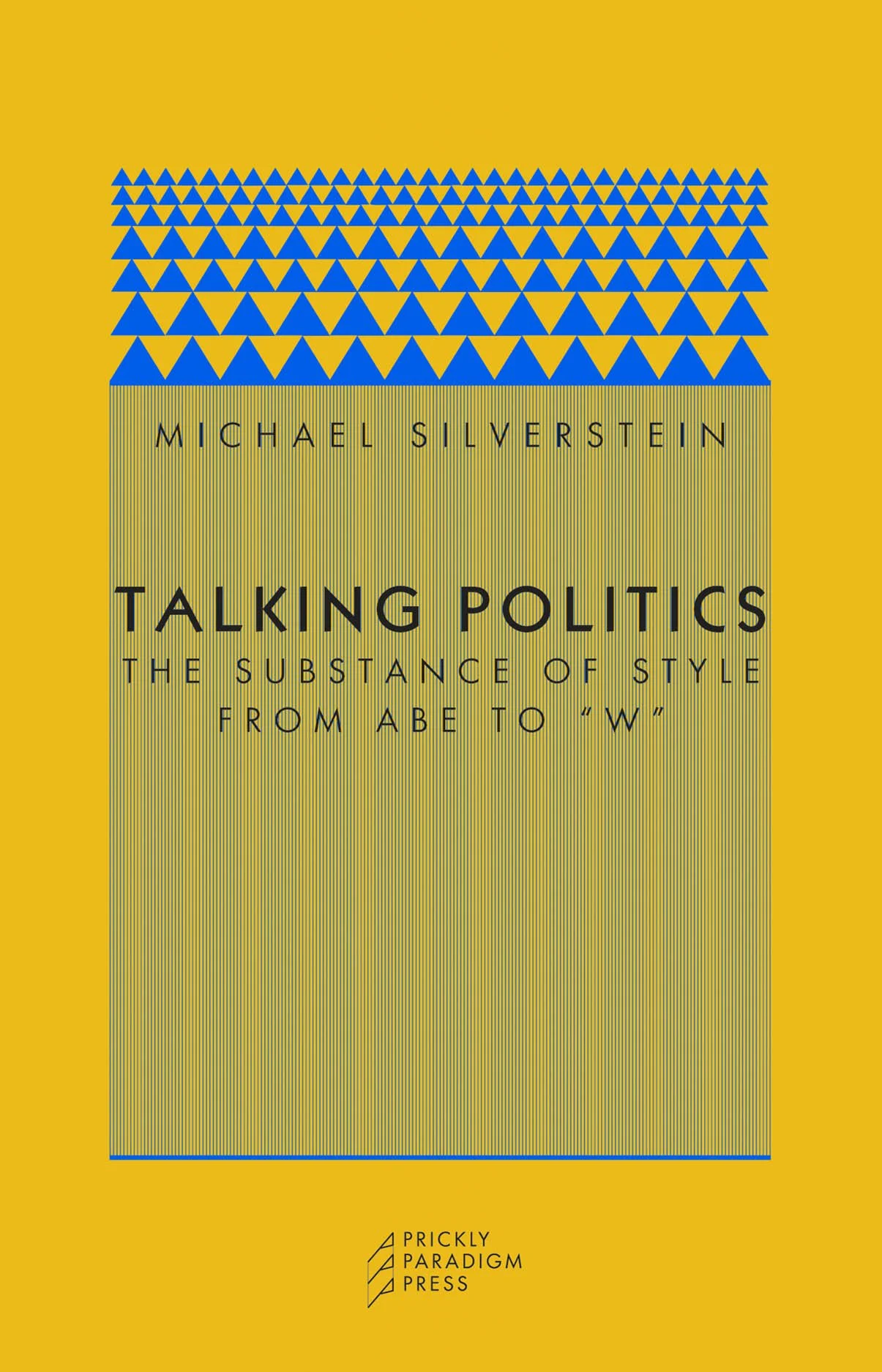
Talking Politics | The Substance of Style from Abe to “W”
If politics as practiced is talk, then how does a political figure—especially an American President—talk politics? If someone can be all style and no substance, is there any actual political substance to style? Talking Politics looks at the alpha and omega of presidential image, its highs—Lincoln at Gettysburg—and lows—“W” at any microphone—demystifying the spun mists of political “message” on which an institution like the American presidency has always depended.