5. A Time Without Universities
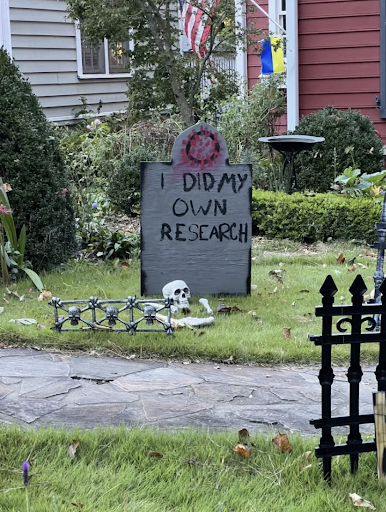
“‘I did my own research,’” Newsweek (October 7, 2022)
A distinguished former university president of my acquaintance has shared with me a story she sometimes tells, knowing that it might be apocryphal, about a remark purportedly made by Hitler to “someone who dared warn him that purging the German universities of Jews and ‘politically unreliable’ members would mean the loss of his country’s scientific preeminence.” Hitler’s response was: “Well, if that is what it takes to rid Germany of Jews, then we’ll just have to do without science for a time.” She, the former university president, goes on to pose the ironic question for this moment in U.S. history: “Can we do without universities for a time?”
The programmed unknowingness of the Trump era is perhaps most consequential for science and medicine. The withholding of billions in scientific funding for universities has already disrupted major research in both the physical and biological sciences. The National Institutes of Health terminated or froze 5,843 research grants in 2025; the National Science Foundation total was 1996. The American and global scientific communities have excoriated the Trump administration’s cuts to initiatives aimed at studying climate change and policies designed to limit its damage. In their public appearances, administration officials in the relevant departments and agencies have developed the practice of giving a cagey answer to a straightforward question about the causes of climate disruption into a minor art form.
In the field of medicine, we should not have expected much from the second term of a president who, in his first term, recommended that Americans inject bleach into their veins as a remedy for the COVID-19 virus. And yet he has outdone himself. There is no question that the most egregious defiance of scientific knowledge by this administration so far has been the appointment of RFK Jr. as head of Health and Human Services (HHS)—part of a deal made for his public support of Trump at a crucial juncture in the 2024 presidential campaign. The playbook at HHS has been much the same as in other agencies under Trump. Cut funding, fire people who don’t agree with you, hire those who do, no matter how absurd their credentials, and then push out a series of rapid decisions with disastrous consequences. In RFK Jr.’s case, these decisions typically both lack scientific foundation and carry life-and-death consequences for millions of Americans. In August 2025, to the astonishment of virtually the entire American medical establishment, RFK Jr. cut research for the development of mRNA vaccines, which, unlike bleach, probably saved millions of lives during the pandemic. In December, his hand-picked panel at the CDC overturned its long-standing policy to give infants the hepatis B vaccination, which has been reported by the World Health Organization to induce immunity with a 95 percent success rate.
Long known as an antivaxxer, RFK Jr. published a solitary article linking vaccines to autism, “Deadly Immunity” (2005), in Rolling Stone, based on research that The Lancet and the British Medical Journal later retracted as fraudulent. Rolling Stone itself retracted the piece, and Salondeleted it from its website, although its uncorrected version continued, and continues, to circulate on the internet. In April 2025, RFK Jr. publicly advised parents of newborns to “Do your own research” on vaccinations. The advice is to trust the internet, where, as he was well aware, his own erroneous and uncorrected version of “Deadly Immunity” can still be found, along with much other erroneous information. By implication, the sort of vetting that led to the retraction and removal of the article in the first place is to be discounted as interference by the people Steve Bannon calls “the clueless elites.”
RFK Jr.’s sloganeering advice became a grotesquely comic meme during the COVID-19 era. For Halloween 2022, one kind of display for trick-or-treaters involved a skeleton or a gravestone bearing the words: “I did my own research.” But the situation has only grown more challenging with the increasing deployment of various forms of AI, especially the new Large Language Models (LLMs). Some observers wonder if these new technologies make the work of universities redundant or somehow beside the point. But the contrary argument is surely the stronger one: that the rise of LLMs makes the role of universities in producing and curating knowledge more crucial than ever. Scientific journals are flooded with fake papers. Carefully vetted technical work has issued from this same university system to raise worries about “model collapse” in the vast deployment of LLMs, and about threatened “hallucinations” in the information landscape that these programs are in the process of creating. Halloween revisited. Alarmingly but unsurprisingly (how often those adverbs appear together these days!), the big report released in May 2025 to much fanfare by RFK Jr.’s HHS proved on examination to include fake sources, some obviously generated by AI.
Like Alex Jones, the snake oil huckster who lost $1.5 billion and his Infowars empire in a lawsuit over his claim that the 2012 Sandy Hook school shooting was a hoax, Steve Bannon was an early supporter of RFK Jr.’s bid for the presidency. After Trump made his deal with RFK Jr. and won the 2024 election, Bannon told the Wall Street Journal that he welcomed what he called the “fusion” between his MAGA movement and RFK Jr.’s MAHA (Make America Healthy Again) movement. Surely Bannon saw an ally who would bring in supporters Trump might otherwise lose—the Kennedy family had been synonymous with the Democratic Party for years—but also could advance his war to destabilize established systems of knowledge and information.
Like Bannon, RFK Jr. challenged existing institutional expertise in the name of a savvy populace capable of doing its own research. Like Bannon—but, in view of his family pedigree, even more preposterously—RFK Jr. now identifies as a “populist” seeking to “take this country back” from “elites and corporations,” the combination “of state and corporate power that is strip-mining the middle class.” His full-throated support for the U.S. withdrawal from the World Health Organization is a good instance of how his views also tally with Bannon’s critique of the so-called globalists.
The alliance Bannon envisioned between MAGA and MAHA, along with the Heritage Foundation’s efforts to take control of education, has done much to shape the second Trump administration’s aggressive agenda. It goes without saying—though it is said every day—that the prosecution of this agenda poses unprecedented threats to the American political, ethical, and cultural fabric as we have known it. Moreover, on Bannon’s explicit advice to “flood the zone” with frantic political activity, the outrageous moves come fast and furious. Some (deploying the National Guard in Los Angeles and Chicago, the ICE “Operation Metro Surge” in the Twin Cities of Minnesota, building a $300 million [then $400 million] ballroom for the White House) seem calculated to produce outrage, while others (the threats to prosecute Obama, James Comey, Letitia James, John Bolton, and Jerome Powell or the corrupt schemes involving Bitcoin) appear motivated by resentment, retaliation, or greed. It is hard to find words for some of the most extraordinary moves—not just the willingness to accept a massive luxury jet as an all-but-personal gift from the Qataris but also, in order to pay for its massive renovation, the clawing back of nearly a billion dollars (from the Pentagon’s Sentinel program) initially intended to modernize aging nuclear missile silos in Minnesota.
Many of these developments seem without precedent, and may well be. Yet the ideological elements of the battle plan for Trump’s gilded populism have been around for a while. Some date to the postwar era, including the Tea Party movement, launched by Newt Gingrich in the 1990s; the frontal attacks on America media by Richard Nixon and Spiro Agnew around 1970; and the anti-intellectualism of the attacks, mainly by Nixon and Joe McCarthy, on Adlai Stevenson in the 1950s. Universities faced political censorship during that same decade’s McCarthy hearings, in which Trump’s mentor Roy Cohn played so large a role. But there are much longer and deeper historical precedents.
I have argued throughout that certain other important reference points for the present moment lie in the Know-Nothing movement and its stoking of anti-immigrant sentiment in the 1850s. But the roots of certain key tendencies now so egregiously evident in American politics go back even further—perhaps to the Founders, but certainly to the two-term presidency of Trump’s personal hero, Andrew Jackson (1829–1837). The fact that Jackson came after the succession of Founder Presidents is only one of the reasons his presidency is sometimes taken to mark a new beginning for the young nation. Another is his strongman populism, which explains why Trump likes to pose next to the large portrait of Jackson that he installed in his redecoration of the newly gilded Oval Office.
At the beginning of Jackson’s term, a young French aristocrat, Alexis de Tocqueville, arrived in America with his friend Gustave de Beaumont, to see for himself how democracy was faring here. Across Europe, Tocqueville witnessed an ongoing struggle in his time between democratic and antidemocratic forces. Although some of his own ancestors had been executed during the French Revolution, he expressed little doubt about which way things were headed. Tocqueville saw his moment in Europe as part of a long and irreversible process of democratization that had been ongoing for centuries, one that the French Revolution had both accelerated and set back but could not finally disrupt. His American quest was to see how democracy worked in a nation where it was not a late development but a founding principle. Tocqueville and Beaumont toured the country for nine months in 1831, then each wrote a book about what they saw and heard. Beaumont’s was a provocative antislavery novel, Marie, of Slavery in the United States(1835). Tocqueville’s book, Democracy in America, published in 1835, remains one of the most important works ever written about American politics and a cornerstone of modern political thought.
Tocqueville met with President Jackson and treated him respectfully in his famous book, though he pointedly observed that the whole generation of leaders after that of the Founders represented a decline in the quality of American statesmen and did not exclude Jackson from that judgment. Never content to observe without analysis, Tocqueville took pains to explain the decline by pointing out that an urgent national challenge, like liberation from British tyranny or the making of a constitution, calls out talents that the ordinary business of politics does not. The problem of finding leaders fit to serve was not so severe in his eyes as to pose a serious threat to the great American experiment. One threat he did see as serious, however, he bequeathed to modern political thought as “the tyranny of the majority.” Under this now-familiar rubric, Tocqueville addressed the problem of American populism.
The tyranny of the majority arises in part as a consequence of the crucial democratic institution of the vote. The side that loses a popular election or referendum must submit to the will of the side that wins. Tocqueville understood that the Framers of the Constitution were aware of this and commended them for taking measures—unpopular among Democrats today—like creation of the Senate Chamber, with two members per state, and the Electoral College. Other aspects of the problem are more nuanced and less easily remedied.
One subtler and more powerful manifestation of the tyranny of the majority shows in its effects on political expression in America. This deeper problem is not primarily majoritarian-minoritarian relationships. In fact, it cannot be understood simply with regard to the people whose sovereignty makes the democracy what it is; rather, it has to do with the relationship between the people and their leaders. One of Tocqueville’s first encapsulations of the point comes in these simple observations: “I have heard Americans speak of their homeland. I have met with true patriotism among the people. I have often searched for it in vain among their leaders.” This is one of Tocqueville’s central puzzles, and he explicates it first by invoking a familiar picture of the monarch or emperor who dominates those he rules and then turning it upside down to challenge received assumptions about leadership and sovereignty: “This fact [about the American people and their leaders] is easily explained by analogy: despotism corrupts the person who submits to it far more than the person who imposes it. In absolute monarchies, the king often has great virtues, but the courtiers are always vile” (301).
How this paradox works in practice is illustrated in Tocqueville’s marvelous description of how leaders flatter their patriotic sovereign, the American citizenry, with the rhetoric of populism:
To be sure, courtiers in America do not say “Sire” and “Your Majesty,” a great and capital difference. But they do speak constantly of their master’s natural enlightenment. They do not offer prizes for the best answer to the question, “Which of the prince’s virtues is most worthy of admiration?” for they are certain that he has all the virtues without having acquired them, indeed without wanting to acquire them. . . . But in sacrificing their opinions to him, they prostitute themselves. Moralists and philosophers in America are not obliged to shroud their opinions in veils of allegory, but before venturing a nettlesome truth they say, “We know that the people to whom we speak are too far above human weaknesses ever to lose control of themselves. We would not speak thus were we not addressing men whose virtues and intelligence so far outshine all others as to render them alone worthy to remain free.”
Could Louis XIV’s sycophants have been any more adept at flattering their master? (301)
Crucial here is the question of intention, for implicit in Tocqueville’s “analogy” is the clear understanding that, like courtiers under an absolute monarch, politicians do not flatter their sovereign without ulterior motives. It is in this sense that they are said to be corrupt, to “prostitute themselves.”
Ultimately, the aim of the courtier’s sycophancy toward the king is to gain control over him, and the American leader’s sycophancy toward the sovereign populace is likewise a power grab. According to Tocqueville’s deeper analysis, a politician’s motivated flattery of the sovereign populace threatens to put America on the road to a different kind of tyranny, the tyranny of the populist leader’s form of rule. The bargain is deceptively simple. Trust me, the authoritarian populist says to the people—trust me to govern you as I please, for I alone truly understand your unalloyed greatness. The upshot is the revelation that the purest form of democracy has within it the possibility of turning democratic rule into its authoritarian opposite.
The application to our own moment hardly needs to be spelled out: Steve Bannon’s all-power-to-the-people rhetoric and Trump’s claim to “love the poorly educated” paved the way, it is now clear, for putting National Guardsmen and ICE agents on the streets of American cities. Despite flattering his MAGA followers’ sense of victimhood with the promise to be their “retribution,” Trump has used the increasingly unbridled power of the executive office to carry out intensely personal vendettas. Especially in this second term (to state what must now be utterly obvious even to a distant observer), he has also dressed his office—including his literal office in the White House—with the golden trappings of monarchy. Hence the strong purchase of “No Kings!”—one of the slogans of the opposition movement against Trump. And of course, sycophancy is itself now on almost daily display in the truly revolting spectacle of cabinet members kowtowing to Trump and corporate heads bearing gifts to the gilded Oval Office.
“We should not at this dark hour forget the insight and the foresight of Tocqueville’s brilliant dialectic, which shows how the tyranny of the majority in a democracy can revert to the very form of despotism it seeks to replace. ”
We should not at this dark hour forget the insight and the foresight of Tocqueville’s brilliant dialectic, which shows how the tyranny of the majority in a democracy can revert to the very form of despotism it seeks to replace. Just pause to consider our state of affairs in the light of it: if you had set out to draw from scratch a fictional illustration of the problems Tocqueville saw in Jackson’s America of the 1830s, you could scarcely have done it better than what the second Trump administration has delivered in the kayfabe spectacle of our nation’s current political reality.
Surveying the American scene for a “counterweight” to some of the threats he saw as inherent in democratic populism, Tocqueville claimed to find it in a group that has not infrequently become the butt of American humor, the lawyers:
The special knowledge that lawyers acquire through the study of law assures them of a distinctive rank in society. They constitute a kind of privileged class among the intelligent. The practice of their profession brings daily reminders of their superiority. They are masters of a body of knowledge that, while necessary, is not widely understood. (303)
John Stuart Mill, another leading founder of modern liberalism, reviewed Democracy in America at great length on the appearance of its English translation in 1836. Mill took special note of the importance of Tocqueville’s discussion of the legal profession as a hedge against the dangerous tendencies he saw in full-on populism. Mill took the exception allowed for the role of lawyers as evidence of a larger acknowledgment “that there is no indisposition in the Many of the United States to pay deference to the opinions of an instructed class, where such a class exists, and where there are obvious signs by which it may be recognized” (137).
Mill seized on this promising “lack of indisposition” as something that would augur well for America’s future, imagining that one day the nation’s increased economic prosperity might go far to solve the problem of producing such a “class.” However, he had reservations about the lawyers’ fitness for the large role they were being called upon to play. For Mill, the learning of this particular “instructed class,” the legal profession’s body of knowledge, was too technical, and too rote, to serve the needs of the young democracy:
If the minds of lawyers were not, both in England and America, almost universally perverted by the barbarous system of technicalities—the opprobrium of human reason—which their youth is passed in committing to memory, and their manhood in administering,—we think with our author that they are the class in whom superiority of instruction, produced by superior study, would most easily obtain the stamp of general recognition. (137)
In Mill’s counterfactual argument, if legal minds were not misshapen (“perverted”) by their education and the practical necessities of their profession, they would have the profile requisite for saving America from Tocqueville’s “tyranny of the majority.”
For Mill, in other words, the American lawyer represents only a flawed incarnation of an “instructed class,” too caught up in both technicalities and practicalities. In the terms that we have learned to use partly from Mill himself, we would now say that an education that goes beyond the technical and the practical is “liberal”: an education that opens a mind to free discussion and new ideas and helps it to become more deliberative in its habits, more analytic in its encounters with the world. Here then is another crucial link between the history of the early Republic and the current crisis, even as we look to jurists to protect what is left of the rule of law in America.
The 1830s in America, as surveyed by Tocqueville and Mill, was, with few exceptions, a time without universities. Mill cites verbatim Tocqueville’s pithy observation: “Elementary instruction is within the reach of everybody: superior instruction is hardly attainable by any” (135). The vaunted American system of higher education—“superior instruction”—would not begin to take shape until a half-century later, after the Know-Nothing movement, after the Civil War. When this system did take shape, it incorporated many of Mill’s ideas about what an educated citizen should look like. “Liberal arts” became the rubric under which countless small colleges were founded and promoted across America. Bard College, where, as I noted earlier, Kenneth Stern teaches students how to think about the problem of hate in the modern world, is one such institution.
Some colleges, like Yale (1887) and Rutgers (1924), became universities. And a liberal arts undergraduate curriculum was also installed at the heart of new research universities. Some were private institutions (like Johns Hopkins [1876], Stanford [1885], and Chicago [1890]) but many were indeed public and flourishing in states like Wisconsin (1848) and California (1865). In many of these new research environments, modeled in part on the German research university, the commitment to natural scientific discovery—Naturwissenschaft—was crucial to the mission. But even in the most “technical” and “practical” of these institutions of higher learning, the teaching of the liberal arts had its acknowledged importance: both MIT (1861) and Caltech (1891), for example, included the arts and humanities as a core piece of their undergraduate programs.
There are many ways the new system of American higher education answered Tocqueville’s and Mill’s worries about the seeds of tyranny that they detected in unalloyed democratic populism. Their own capacity for imagining such a system suffered from at least one severe limitation. Mill delivers the upshot of his counterfactual fantasy about what the lawyers could become if they were educated more liberally: “they would be the natural leaders of a people destitute of a leisured class.” Repeatedly, Mill’s remarks on liberal education fail to go beyond a residual investment in class thinking. He was one of the first thinkers to offer what Thorstein Veblen would later, with very different intent, call “the theory of the leisure class.” Here is Mill’s formulation:
A leisured class would always possess a power sufficient not only to protect in themselves, but to encourage in others, the enjoyment of individuality of thought. . . . A class composed of all the most cultivated intellects in the country; of those who, from their powers and their virtues, would command the respect of the people, even in combating their prejudices—such a class would be almost irresistible in its action on public opinion. In the existence of a leisured class, we see the great and salutary corrective of all the inconveniences to which democracy is liable. (137)
Mill’s talk of the benefits of a leisured class, here and elsewhere, must have sounded a jarring note in contemporary American ears—and, let’s face it, it still does today. A creature of the age of liberal reform in Britain, writing in the wake of Britain’s Reform Act of 1832, he had not shaken the class system and the politics of inheritance championed by political thinkers like Edmund Burke. Thus, for all his praise of American democracy, Mill agrees with Tocqueville that America lags behind other nations in certain key respects: “in countries where there exist endowed institutions for education, and a numerous class possessed of hereditary leisure, there is a security, far greater than has ever existed in America, against the tyranny of public opinion over the individual mind” (137). Mill certainly seems here to have trouble imagining such a system of “endowed institutions for education” apart from “hereditary leisure”; —presumably he can only conjure bastions of privilege like Oxford and Cambridge.
In his role as a public servant, though, Mill was more than a little capable of such imagination, and with impressively concrete results. In 1836, the very year he was writing his long review of Tocqueville, the new University of London opened its doors. The innovative plan for this institution was conceived on a plan drawn up ten years earlier by a group of utilitarian liberals including both Mill and his father, James Mill, and of course Jeremy Bentham, typically thought of as the founder of “the Godless Institution on Gower Street.” The young Mill served on its first board of directors. This university rightly prides itself on its enviable record of “firsts.” It was the first British university “to admit students regardless of their gender, race or religion, and to admit women to degree programmes.” The overarching goal now avowed by the University of London is simply expanding “access to a wide range of academic opportunities.”
That aspiration toward wider and wider student access came to be emulated in America with real success over time—uneven, to be sure, but real just the same. And in this aspiration too lies the key to uncoupling Mill’s views about liberalism from his views about class. There remain traces of hereditary privilege in the American system, but they tend to benefit the oligarchical class Trump ultimately serves. “Legacy” admissions preference, which some universities had themselves been reducing, does not seem to be high on the list of charges brought by Linda McMahon’s Department of Education. For a populist like Steve Bannon, for whom (for reasons that Tocqueville’s and Mill’s analyses make clear) an educated citizenry poses serious problems, there is every incentive to cast and castigate educated Americans as a monolithic “class” of globalist elites. Yet the evidence to support such a view has been attenuated with every measure taken to broaden access to higher education—every time a student gains admission as a first-generation college student or the horizon of higher education is expanded and transformed in other ways.
Mill and Tocqueville also make clear that an educational program grounded in classically liberal values should in principle foster the opposite of the groupthink characteristic of a particular “class.” For Mill, after all, the tyranny of the majority also involves the tyranny of public opinion over the individual mind. Thinking of liberal education as the solution to Mill’s problem returns us to the figure of Kenneth Stern at Bard College, the lawyer (as it happens) turned educator. As I noted earlier, Stern drafted the International Holocaust Remembrance Alliance definition of antisemitism but now vehemently protests its weaponized deployment by the Trump administration to shut down debate on campus. Stern has not minced words. He sees in J. D. Vance’s comments and in the Trump administration’s actions an emulation of Viktor Orbán’s tactics in Hungary: “Attacking liberal education and seeing it as the enemy.”
No doubt agreeing with Mill and Tocqueville that liberal education should overcome groupthink in principle, Stern does not believe that colleges and universities are doing all they might to keep it robust:
[They] may, abstractly, be doing a good job teaching students facts and theories associated with a wide range of academic disciplines. But they usually do not help students step back and think about how they think. That’s a shame. Because if students were more aware of our innate tendencies, using brains developed over millennia to see ingroups and outgroups, they’d help produce graduates who crave complexity, and who think more clearly. (Stern, The Conflict Over the Conflict: How the Israel/Palestine Campus Debate Is Eviscerating Academic Freedom, 37)
Stern is not alone in this view, but certainly he himself, like many other American educators, is doing his part. He is director of the Bard Center for the Study of Hate, and his courses attempt to understand that complex problem with open discussion from a number of angles.
Stern’s recent course for Bard’s Lifetime Learning Center was titled “Hate: What and Why?” The questions to be addressed are available to the public:
What is hate? What is it not?
Is the potential for hate embedded in human psychology or is it learned?
Under what conditions can people live together peacefully, and then turn on each other?
How important is the media in teaching us to hate?
What is the relationship of structural racism and individual prejudice?
Consider the contrast between Stern’s thoughtful pedagogy on these very real questions and the snarky rhetorical question posed to Harvard by the former WWE President and performer who now serves as Secretary of Education: “Why is there so much HATE?” And then ask yourself: Could Stern’s Bard College course fail to make the ideological hit list for McMahon’s Department of Education? For starters, it discusses antisemitism in relation to racism—even to “structural racism”—fast becoming one of the taboo topics of our Orwellian moment. Trump and McMahon haven’t gotten to the liberal arts colleges like Bard yet, but only because they have begun with bigger game. If a course like Stern’s were taught at a research university—Cornell, say, or Northwestern, or Virginia—it could appear prominently on the government’s list of charges intended to justify the suspension of billions of dollars in scientific funding and even, in the case of Virginia, the ousting of the university president.
In the face of both the Trump administration’s attacks on universities and RFK Jr.’s public undermining of medical science, most recent defenses of American higher education have focused on the question of scientific research. Such defenses are absolutely necessary in light of the urgent and palpable stakes. Government-imposed disruption of academic cancer research, for example, ought to raise a red flag for people everywhere. A modest little website launched by academic researchers—“What We’ll Never Know”—has begun to spell out the scientific costs of some of the recent cuts to scientific work. There will be further such revelations about the consequences of these cuts as time goes on.
It is hard to say how much these disruptions bespeak an opposition to science itself, though Steve Bannon often uses the (for him) pejorative epithet “scientific” when he is lashing out at “globalist elites.” Trump’s Secretary of Education certainly cannot be counted among the staunchest supporters of academic science. Yet when the Trump administration makes its challenges to our universities, the charge is typically not that they are doing too much science and have to be stopped. The charges are more typically aimed at courses like Ken Stern’s. “Structural racism,” according to the Trump administration, is not a concept that should be included in a course at Bard’s Lifetime Learning Center, nor for that matter in a college curriculum of any kind. It reflects what they and their supporters like to call “liberal bias,” which they insist must be stamped out at any cost.
This is not the place for a full stock-taking of the modern American university, which obviously still has a long way to go to realize its highest aspirations. It is not even clear that it had lately been heading in the right direction. The political theorist Wendy Brown has described a “hollowing out” of the liberal values that made “the North American twentieth century, for all its ghastly episodes and wrong turns, retroactively appear as something of a golden age for public higher education” (Undoing the Demos: Neoliberalism’s Stealth Revolution [2015], 180). In this period, she writes, a college education “inclusive of the arts, letters, and sciences” became “the door through which descendants of workers, immigrants, and slaves entered onto the main stage of the society to whose wings they were historically consigned.” Democracy itself demanded this. Citing Tocqueville by name on the dangers of a “citizenry left to its (manipulated) interests and passions,” Brown argues that while democracy “may not demand universal political participation, . . . it cannot survive the people’s wholesale ignorance of the forces shaping their lives and limning their future.” Hence her approval of the 1946 President’s Commission, which declared “higher education . . . an investment in a bulwark against garbled information, half-truths and untruths, against ignorance and intolerance” (28).
Brown makes clear, however, that public universities have done far more to educate a democratic citizenry than private ones, and she is aware that even public universities at their best had major blind spots (“aporias and occlusions”). They succeeded better in “articulating equality as an ideal” than in producing real social—or even educational—equality. More damningly, though, her view is retrospective. She sees the mid-twentieth-century liberal vision of the university as undergoing replacement by a neoliberal one in which all values are reduced to economic values, while the subject of education has shifted from the person and the citizen to the “job holder,” understood as “human capital.” Increasingly, “the market value of knowledge—its income-enhancing prospects for individuals and industry alike—is now understood as both its driving purpose and leading line of defense” (187). Brown knows that American higher education has long been vulnerable to such tendencies. One need only think of Thorstein Veblen’s trenchant and far-sighted 1918 analysis of the influence of commercial corporations in academic affairs, The Higher Learning in America, a kind of sequel to his Theory of the Leisure Class. But many informed observers of American higher education would agree that universities have devolved in the ways that Brown has detailed since what she calls its heyday in the 1960s.
In the first conclusion I composed for this final chapter, I had been too defensive, insisting that, “unlike many of those that attack them, liberalism and its university are inherently and properly self-critical,” and adding that although this can often seem like a weakness it is something to be cherished and not exploited. But a different and perhaps truer argument would urge that the liberal university has not been self-critical enough to evade the neoliberal takeover. Crucially, this takeover predates the anti-intellectual campaign of the MAGA movement: Brown’s analysis of neoliberalism in higher education dates to 2015, just before Bannon and Trump teamed up to Make America Know-Nothing Again. Her critique, one among many that might be cited, would seem to imply more troubling answers to the question of why universities, with few exceptions, have defended themselves so ineptly in the current crisis.
To connect the willed ignorance of RFK Jr. with the targeting of courses like Kenneth Stern’s is to see that, beyond academic science itself, the foundational liberalism of the modern university is also under attack in this moment. And it is being threatened for just the reasons that Tocqueville and Mill vividly anticipated. The recent academic coinage “authoritarian neoliberalism” might sound like a contradiction in terms, but it comes close to capturing something important about our moment, including the distinction between liberalism and neoliberalism. In these dark times, it is perhaps clearer than ever that the study of the liberal arts and sciences remains a crucial Tocquevillean “counterweight” both to populism and to the authoritarianism it can spawn. For the authoritarians themselves, this counterweight is just “liberal bias.” Critiques of both liberalism and the institutions that embody it have often been harsh, by no means always unjust, and where they are just they must be heeded. But a year into the second Trump administration, we have begun to learn, in the starkest of terms, what it could look like to see our sites of knowledge and liberal education brought under hostile control and transformed beyond recognition. It is time perhaps to ask ourselves: Can we once again imagine doing without universities for a time?