4. A Game of One-Dimensional Chess
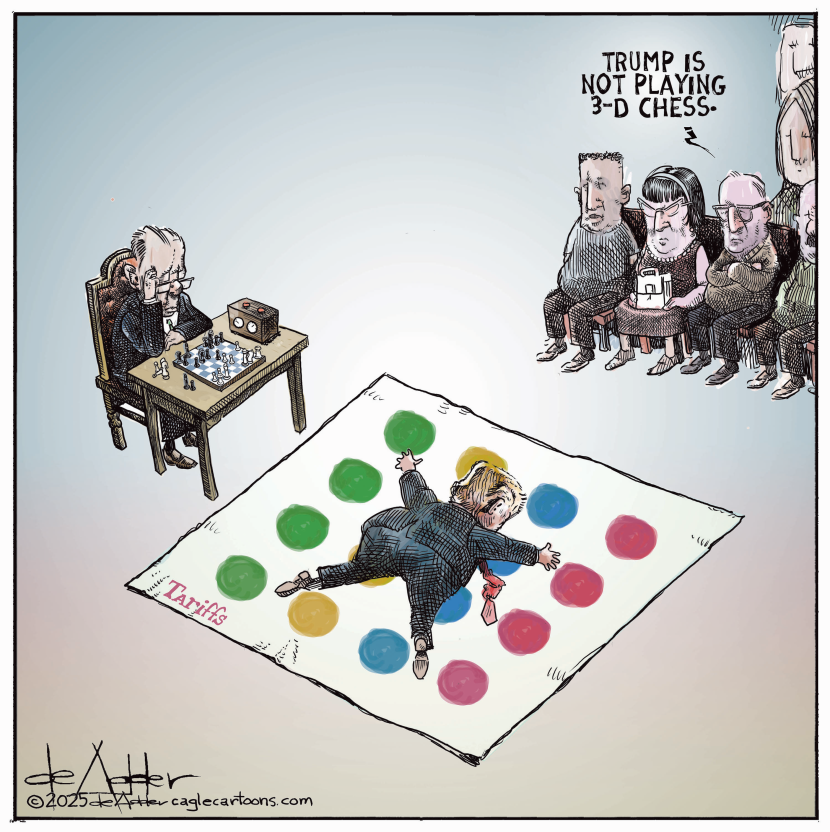
Michael de Adder, Trump Is Not Playing 3-D Chess (2025). cartoonstock.com
Back in November 2015, when Steve Bannon conducted his series of three interviews with the man he hoped would bring victory for his Know-Nothing MAGA movement, Trump did not, like Bannon, pose as an enemy of the so-called intellectual elites that Bannon was fond of bashing, or as a critic of “immigrants.” In fact, Trump specifically told Bannon on this occasion that he thought the country should find ways to keep the international students who managed to “do great” in our finest institutions of higher learning. Trump is rather more concerned to present himself as an eminent example of someone who managed to “do great” academically and continues to shine in all spheres of knowledge and intellect. How many times has he boasted about how much he knows about, say, science? He has declared himself not only part of the intellectual elite but also, notoriously, a “stable genius.”
That kind of boasting, to which we have become so inured over the past decade, is already fully on display in the 2015 interviews, but the claims Trump wants to make for himself sometimes clash with the picture Bannon wishes to offer his listeners. In the November 3 interview, Bannon had disparaged his own education at Wharton, saying that all he had learned there was “supply and demand.” In the November 19 interview, however, Trump crows about his academic success in the Ivy League:
[Trump] Numbers just came out in New Hampshire, numbers just came out, Fox just announced numbers on other things and, you know, I’m leading on everything and leading not by a little bit but by a lot, but I have to say, you have to stop using the word “the intellectuals.” I went to an Ivy League school. I was a very good student. I’m more of an intellectual than I think anybody—
[Bannon] By the way, our audience here on Sirius XM Patriot and at Breitbart, where I say every day these working-class men and women, middle-class men and women are 10 times smarter than this intellectual group.
[Trump] … What can I tell you? Four months, five months. And I’ve been really very focused and when I focus, I focus. I’ve been watching these guys [on television]. They’re wrong on everything. They are wrong so much. So don’t call them the elite. Don’t call them intellectuals. Call them establishment guys. You could say they’re establishment because they’ve been there a long time. I think, “establishment,” but you should never use the word “elite.” I mean you should call me an intellectual. You shouldn’t call them an intellectual.
While Bannon wants to castigate intellectuals, Trump still wants to be seen as one. And yet Bannon nonetheless finds a way to flatter Trump’s intellectual pretensions, setting a template for the kind of toadyism that sadly continues to this day.
A few weeks after his brilliant commentary on Trump’s Oval Office meeting with Zelensky in February 2025, Jon Stewart returned to that strange episode by referring to a game with rules very different from those of professional wrestling. Mocking the hyperbole with which right-wing news outlets celebrate the genius they claim to find in their superhero president, Stewart offered a quick sequence of four short video clips. It begins with TV judge Jeanine Pirro summing up the February 28 meeting on Fox News’s The Five: “Zelensky is playing checkers,” she declares, “while Trump is playing chess.” In a second video, from a different episode, Fox host Laura Ingraham insists that Trump’s strategic thinking amounts to “three-dimensional chess.” In a third clip, a talking head in a suit proclaims: “four-dimensional chess!” Ultimately, as if not to be outdone, a final commenter takes the prize: “five-dimensional chess!” Stewart rounds off this comic bit with his own telling punch line. Posing a question about what Trump’s so-called five-dimensional chess would even look like, he suddenly reaches under the desk and pulls out a chess board already set up for a game, white pieces on one side and brown pieces on the other. “How would he do it?,” Stewart wonders aloud, gazing at the board. And then, with a sweep of his arm, he clears off the brown pieces: “First, we lose them for DEI . . .”
Like Stewart’s more elaborate bit about Trump and the world of wrestling, this simpler one debunking claims about Trump’s tactical wizardry has stayed with me. But I have found myself wanting to take it in a different direction. Far from “five-dimensional chess,” or what Steve Bannon called Trump’s “outside the universe” thinking, Trump’s characteristic moves, especially over the first six months of his second term, seem rather to have fallen into a certain predictable pattern, in keeping with his penchant for the dealmaker’s fantasy of the “sure thing.” His are the shortsighted decisions of a distracted, impulsive mind that latches on to the concept of a “win-either-way” proposition. This is not to be confused with the more familiar “win-win” deal enshrined in classical political economy, in which both sides benefit from a good bargain. The Trumpian idea of “win either way” is a dream of maximizing his own advantages irrespective of how the flipped coin lands—“heads I win, tails I win”—as if he had put his face on both sides of the new national 250th anniversary gold coin. The posture is not so much self-interested (in Adam Smith’s sense of the term) as self-obsessed. Such an approach to decision making is so narrow that it misses the wider array of adverse outcomes. Even within a narrowly utilitarian calculus, what Trump is playing is not even checkers. It’s more like a simplified fantasy of chess played on a single row, with just a king and a line of pawns.
For a case in point, consider again the meeting with Zelensky. Trump notoriously told him in the Oval Office that afternoon: “You don’t have the cards right now.” (True, it’s a metaphor taken from yet a different kind of game, but we can work with it.) He would remind Zelensky of that admonition eight months later, in late November 2024, when the Russia-friendly “28-Point Peace Plan” was rolled out. Implied but not stated in that initial announcement was that Trump was taking Zelensky’s cards away in the very act of saying he lacked them. His words to Zelensky might be decoded this way: You can no longer stand up to Russia because we are defunding your effort to do so. Stewart may be right in speculating that the goal of this surprising move was to tip the outcome of the war, taking Russia’s part against the European alliance and the European Union itself. If not dealt replacement “cards” by Europe, Zelensky would clearly have to capitulate to Putin.
Indeed, Trump’s chief diplomatic efforts over the next months consisted primarily in consulting the Russians unilaterally about the terms on which they would be willing to stop the war. The end, with Russia appeased, would thus, as Stewart and others suggested, count as a win in Trump’s mind. But there is another possibility, another outcome of the coin flip. What if the Europeans stepped up their levels of financial and military support for Ukraine? The war would be prolonged. More people would die. Russia would not be happy. But should all that come to pass, Trump could nonetheless turn to his MAGA constituency and declare that he had finally succeeded in forcing Europe to pay its fair share in defense spending. He would “win” either way.
Beyond the narrowed scope of the “heads I win” conceit, however, Trump’s move against Zelensky has already had a range of adverse consequences. In taking the cards away from Zelensky and then humiliating him for not holding any, Trump took little account of what it really meant to strengthen Russia’s hand as he did. Since that meeting in March 2025, Putin has made clear that what he imagines as a scenario in which “Russian wins” goes far beyond whatever Trump was able to conceive as a win for himself. Unable to acknowledge, perhaps even to see, the limits of his own one-dimensional chess move with Zelensky, Trump instead went public in late May with the report that “Putin has gone absolutely CRAZY!” And a few days later, Zelensky’s devastating June 1 drone strikes on four Russian airbases showed that he had some cards left to play that Trump was evidently unaware of. In the meantime, the shortsighted move against Zelensky badly frayed the relationship between the United States and its European allies. So much for five-dimensional chess.
Trump’s controversial tariff policy represents another example of this “heads I win, tails I win” tactic. On countless occasions, Trump has insisted that the goal of his tariffs is to bring manufacturing jobs back to America by inducing major corporations to set up shop here rather than abroad. As many sober economic analysts have noted, however, this can only be achieved if the tariffs are generally understood to be stable and long-lived, semipermanent. No major corporation would otherwise consider such a major course alteration, which would take years to carry out. In practice Trump’s tariff policy has produced anything but a sense of long-term stability, because a new and different tariff scenario seems to appear every week. It’s not just that tariff decisions look to be at the mercy of Trump’s whims. They are also frequently motivated by little more than his beef du jour. What does a tariff on avocadoes or coffee beans have to do with American manufacturing?
Trump’s announced willingness to seek negotiated tariff settlements would seem to suggest a very different set of goals from the fantasy of rebuilding American manufacturing. Trump might well emerge from a scenario of negotiated smaller tariffs by claiming new gains for federal coffers, and this might persuade him that in his tariff moves, like his foreign policy moves, he wins either way. But tariff revenue, as we are constantly reminded by economic observers not employed by the Trump administration, is in fact a tax. It is borne initially by the American firms that import foreign goods and ultimately by the American citizens who consume them, and it is a regressive tax at that.
Moreover, readers who have followed the unfolding of Trump’s tariff wars need little reminder of how contradictory and short-sighted his moves on this game board have proven to be. Each new announcement causes markets to bounce up and down. High tariffs on Brazil punish the opponents of strongman ex-President Jair Bolsonaro, and on Canada they punish its recognition of Palestinian statehood—political retaliation rather than economic calculation in both instances. By August 2025, prices were beginning to rise, and Federal Reserve Chair Jerome Powell cited the tariff policy as a reason to not lower interest rates, for which Trump has been menacingly clamoring. In the face of such uncertainty, much of the business world, both at home and abroad, has remained in wait-and-see mode. If there is one thing the business world doesn’t like, as all the economists never tire of telling us, it is uncertainty.
All this was of course well known to anyone remotely keeping up with the news. Bound by the narrow conception of a “win either way,” both of Trump’s decisions failed to reflect even the two-dimensional thinking required for an actual chessboard. Trump remains blind, often willfully so, to a larger field of circumstances in which the adverse consequences of his impulsive maneuvers play out. This pattern extends across a range of other actions, such as the fatal rescission of congressional funding for critical foreign and domestic institutions, like USAID and the Corporation for Public Broadcasting, which announced its immanent closure in August 2025 and ceased operations in January 2026.
Consider in this light Trump’s nomination of flagrantly incompetent loyalists to major cabinet positions. For the most part, these are people whose agenda, like Trump’s, is in no way aligned with the mission of the departments they are supposed to be heading. Linda McMahon as Secretary of Education is not even the most egregious example of this kind of calculated mismatch. That honor probably falls either to Pete Hegseth, the Fox News weekend host appointed as Secretary of Defense, by year’s end enmeshed in scandals over his attacks on nonmilitary maritime targets; or to Robert F. Kennedy, Jr., the medical conspiracist appointed as Secretary of Health and Human Services, whose handpicked panel of antivaxxers has revoked the long-standing Centers for Disease Control and Prevention (CDC) recommendation to administer the lifesaving hepatitis B vaccine to children. Matt Gaetz could well have earned the prize had his appointment as attorney general not been blocked, but the appointments of Attorney General Pam Bondi and Homeland Security Secretary Kristi Noem are both well in the running.
Linda McMahon’s role in the cabinet matters most to the fate of higher learning in America, as it faces threats unprecedented in our history. It is not just that she presides over the gutting of the Department of Education. She also, as became clear in the Trump administration’s menacing of Harvard, emerged as point person for the siege being carried out on American universities. How, then, might Trump’s brand of one-dimensional chess play out for this phase of his increasingly authoritarian strong-arming of American universities?
In an age when “flood the zone” is the byword of MAGA-driven change, it can be difficult to grasp the full range of measures that the Trump administration has taken against universities over the course of a single year. With some, of course, Trump has had the aid of a subservient, Republican-controlled Congress whose crowning achievement to date, the One Big Beautiful Bill Act (OBBBA) (P.L. 119–21) on taxing and spending, was signed into law on July 4, 2025. Several provisions buried in the statute target U.S. institutions of higher education. One is a further elevation of the federal tax rate on university endowments, by which some universities now face rates as high as 8 percent—several times the previous levels. The bill also includes as many as eight major cuts to federal student loan programs, including a provision to end repayment plans such as SAVE (Saving on a Valuable Education). Student loans are capped at a lower ceiling and come with far less favorable interest rates and drastically shorter grace periods for beginning repayment.
The Trump administration did not need Congress to put into effect a new policy of screening the social media of foreign student visa applicants for content it deems politically objectionable. Since the criteria are so broad, it will fall to the official who happens to be investigating a given applicant to make the crucial determination, thus introducing a further level of uncertainty into the review process. The effect of this particular measure on the number of international students coming into this country is chilling: enrollments dropped 17 percent in fall semester 2025. Trump’s urging of this policy is easily enough explained in relation to his brand of one-dimensional chess.
Many international students will not make it through the process, and perhaps many more will refuse to submit themselves to it. There are other countries with good universities and high-quality degree programs across fields, and these are already attracting more and more applications. A reduction in international students is clearly something that Trump now thinks will count as a win in the eyes of Steve Bannon and the MAGA base. Unsubstantiated suspicion about the attractiveness of a university like Harvard to international students was very much at the heart of Linda McMahon’s May 5, 2025, letter to Harvard asking why there is “so much HATE” and what all these international students might have to do with it. But what about the students who do apply and manage to gain admission? On them, the Trump administration will have administered a political litmus test. If students abroad agree with the growing international consensus against both Israel’s war in Gaza and unwavering U.S. support for it, best just to keep them out. But if they do come they need to be reminded that they will continue to be surveilled for “any indications of hostility toward the citizens, culture, government, institutions or founding principles of the United States.” (In October, ICE purchased a new bot, formerly used in Israel, for surveillance of social media and moved rapidly toward building “a 24/7 social media surveillance team” to expedite deportations.) It must seem to Trump that he wins with the international students who never enroll in U.S. universities, and he wins with those who do. Heads I win, tails I win.
“For a president obsessed with the balance of trade, he strangely has little appreciation for higher education as one of America’s most reliably impressive exports.”
The damage done by the Trump administration’s policy toward international students goes well beyond this restricted dimension. For a president obsessed with the balance of trade, he strangely has little appreciation for higher education as one of America’s most reliably impressive exports. Our university system has been the envy of the world and has lured the best and brightest from countless nations to come to study in it. These students enrich the talent pool of our universities and bring diverse experiences in other languages and cultures that contribute enormously to the experiences of the rest of the student body, American students prominently among them.
What’s more, many of these outstanding students have decided to remain in the country where they received this great education, bringing new talent and new perspectives to fields like science and engineering, law and medicine, and, within higher education itself, to teaching and research across all fields, including the humanities and social sciences. American strength across many fields derives in no small part from international human resources. Back in 2015, during his Breitbart interviews with Bannon, Trump seemed to understand this. The world-class reputation of American universities has been the accomplishment of many decades’ work. The successful protocols for bringing in new talent and fresh perspectives from the international community have also evolved over time. In a field of play that is understood to include the vast advantages of this system, who in the world would want to take it down? Who else could imagine calling such a takedown a “win”?
Implicit in the picture I have sketched of the Trump administration are several disturbing ironies. Like other strongmen of the past and present, Trump has resorted to intimidation and bribery to gain unprecedented power. In his case, the ironies arise in how these tools are deployed. One can be found in the relationship between retaliation and whimsy in his short-term decision making. The wrestling world’s practice of kayfabe offers a way of understanding this paradox—a wink at the crowd, a kick in the groin, and the show goes on. A second irony is how Trump’s decision making hovers between impulse (whether whimsical or retaliatory or both) and calculation. Trump’s impulses resolve themselves into recurring short-sighted bets that happen to strike his dealmaker’s fancy as a sure thing, a win either way.
In Trump’s attack on American higher education, however, there is a deeper irony, with origins in the moment when Steve Bannon and David Bossie went to Trump Tower in 2012 to see if Trump might be someone to lead what would become MAGA—their neo-Know-Nothing populist movement against the “globalist elites.” At that point, Trump was a real estate magnate with a checkered history, the star of a reality TV show, and a man with a new penchant for generating false rumors about President Obama’s birthplace. He had little or no sense of ideological orientation. Indeed, he had changed party affiliation several times over the previous dozen years: from Republican to Democrat in 2001, from Democrat back to Republican in 2009 (right after Obama’s election), to “no party affiliation” in 2011, and then back to Republican in 2012. The Donald Trump whom Bannon and Bossie began recruiting that year and whose failing campaign they turned around in late 2016 was already a dealmaker playing one-dimensional chess, a man driven by whimsy and retaliation who used intimidation and money to get his way. But he was not a man with long-term objectives for a major political crusade. The third level of irony when it comes to understanding Trump lies in the interplay of the short-term instincts that have always been his own and the longer-term strategy that he willingly allowed to be foisted upon him.
Another way to put this is to say that the chessboard on which Trump is playing does in fact have a second dimension, with other chess pieces, but that is more important and more legible to the schemers behind his rise to power—Steve Bannon, David Bossie, Steven Miller, Russell Vought, the Heritage Foundation—than to Trump himself. It is true that Trump had some private beefs with universities: in his initial challenge to Columbia, the sum of government funding he threatened to withhold turned out to be exactly the sum he’d hoped to be paid by Columbia twenty-five years earlier in a failed deal that ended in sharp acrimony. His own foray into higher education, Trump University, was of course a humiliating failure. And Trump may well also be sensitive to the fact that he is no favorite on most American campuses. Still, the idea of going after the enrollment of international students does not seem to have been remotely on his radar until his recruitment to the war against “globalist elites” in Steve Bannon’s America First crusade.
American universities have certainly had their own issues over the years; within higher education itself there have been ongoing debates about how to address them and, more important, how to address the problems that legitimately cause public concern: the high cost of tuition, the question of ideological bias, and the question of academic activism. Unsurprisingly, Trump, Bannon, and J. D. Vance (with the Heritage Foundation and Christopher Rufo in the background) have been stoking resentment against American universities and then trading on the results of their work. But do Americans really want to see our universities with diminished influence in the wider world, a provincialized student population, and a curriculum surveilled by the likes of Linda McMahon? Already in May 2025, a substantial majority registered their disapproval of Trump’s handling of higher education. Polls since then have confirmed this opinion as the current assault on universities came to be better understood for its role in the crusade to Make America Know-Nothing Again.
At the start of his second term in office, and within the narrow calculus of a one-dimensional chess game, Trump must have been persuaded by certain advisors that the student protests against U.S. support for Israel’s war in Gaza made for another win-either-way scenario. His big move was to start mobilizing the charge of antisemitism to hold universities hostage to their needs for large-scale scientific research, especially medical research. (Universities with large medical schools have been particularly vulnerable because as of 2023, over half of federal funding for universities goes to the life sciences.) Any university that resists will necessarily find itself on the defensive, in need of millions of dollars to pay for protracted legal battles, and at risk of alienating pro-Israel major donors. If universities are embattled and weakened, Trump thinks he wins. But if they capitulate, as Columbia and Brown and Northwestern have done, they must cough up large settlement payments and accept forced changes to the way they go about their academic business—how they admit not only international students but all students, and how and what the students will be taught. Universities financially weakened or universities controlled and surveilled by government operatives—these are the alternative “wins” of Trump’s campaign, all in behalf of an effort to Make America Know-Nothing Again.
“Whatever greatness America has, or had over the last century and a half, is at least partly dependent on the success of the great universities founded or transformed in the last quarter of the nineteenth century.”
This way lies madness. Whatever greatness America has, or had over the last century and a half, is at least partly dependent on the success of the great universities founded or transformed in the last quarter of the nineteenth century. Made possible by robust commitments of public and private funding, the eminence of the American university has also depended on two fundamental principles: academic freedom and diversity of background. The American Association of University Professors (AAUP) codified academic freedom in 1915 as a supreme value to protect speech and inquiry beyond the provisions of the First Amendment. In the summer of 2025, seven distinguished members of the Harvard faculty sent a letter to university President Alan Garber to urge a staunch defense of these norms. In January 2026, the outcome of Harvard’s negotiations with the Trump administration was still in doubt. But even anti-DEI conservatives like Ross Douthat and Christopher Rufo have discussed the notion that racial, ethnic, and gender diversity can have a specifically academic benefit.
Take away the principle of academic freedom and the drive to widen the horizon of diverse perspectives in the American university and you spell an end to the institution as we have known it. What greatness would be left in the society resulting from such moves is one of the questions I take up next.