It’s Growth, Not Population: Rethinking Sustainability in the Anthropocene
Few issues provoke as much discomfort and polarization in debates about ecological crisis as population growth. In public and policy discourse, population is often treated as an obvious driver of environmental degradation: more people, it is assumed, necessarily means more pressure on ecosystems, resources, and the climate. At the same time, population remains a deeply sensitive topic, burdened by a history of eugenics, colonial governance, and coercive population control. As a result, population frequently appears either as a taken-for-granted explanation or as a taboo subject—rarely as a carefully theorized object of critique.
This chapter intervenes in this impasse from a political ecology and global justice perspective. Political ecology emphasizes that ecological crises cannot be understood independently of power relations, inequality, and political economy. Building on this tradition, I approach population not as a neutral demographic variable, but as a historically and politically charged concept whose significance depends on how ecological crisis itself is framed. In particular, the chapter draws on postgrowth and degrowth perspectives, which challenge the dominance of economic growth as a societal objective and foreground the role of capitalist accumulation, unequal exchange, and high-production and high-consumption lifestyles in driving ecological breakdown. For readers unfamiliar with degrowth, it is important to stress that it does not call for indiscriminate economic contraction or individual austerity, but rather for reorganizing societies to reduce material and energy throughput while improving social well-being and global justice. From this perspective, the ecological crisis of the Anthropocene is not primarily a problem of human numbers, but of historically specific modes of production and consumption concentrated among the wealthy.
The argument developed in this chapter is threefold. First, I argue that the central sustainability challenge in the Anthropocene is capitalist economic growth—particularly in high-income economies—rather than population growth as such. While the global population has increased significantly over the past two centuries, the ecological pressures driving planetary destabilization are overwhelmingly shaped by unequal patterns of production and consumption. Second, by situating population arguments within the broader history of growth critiques, I show why population-focused environmental politics are analytically insufficient and normatively problematic, especially in their tendency to depoliticize ecological degradation and legitimize authoritarian or exclusionary responses. Third, and more tentatively, I explore whether population can be rethought in emancipatory terms by drawing on feminist and anarchist traditions that framed birth control as a project of autonomy, care, and collective self-limitation, rather than external constraint.
Overall, the chapter seeks to move beyond both demographic determinism and population silence. It argues that population can be addressed in an emancipatory way only if it is embedded within struggles over democracy, care, reproductive justice, and global inequality—shifting attention away from managing numbers and toward transforming the social relations that shape both ecological destruction and human reproduction.
Sustainability, Capitalist Accumulation, and the Politicization of Social Metabolism
This section introduces postgrowth and degrowth as political ecology frameworks and explains why critiques of ecological crisis centered on economic growth, rather than population growth, have become central to contemporary sustainability debates. “Postgrowth” and “degrowth” are terms that are increasingly mobilized by scholars and activists to criticize the hegemony of economic growth—but also green growth—and to articulate overlapping proposals for a radical reorganization of “affluent societies” (Galbraith 1958). These proposals aim to achieve a drastic reduction in energy and resource use in order to alleviate ecological pressures and enable global justice while simultaneously improving well-being for all (Kallis et al. 2025). While postgrowth is broader, encompassing well-being and “doughnut economics” and mainly focusing on achieving well-being beyond the growth focus, degrowth tends to be more antisystemic, addressing structural growth dependencies and the consequences of necessary economic contraction, and is more aligned with social movement perspectives (Burkhart, Schmelzer, and Treu 2020; Kallis et al. 2018 and 2025; Keyßer, Steinberger, and Schmelzer 2025).
Degrowth is intentionally provocative. It functions as what some proponents have described as a “missile word,” designed to disrupt the taken-for-granted status of economic growth as a societal objective. At its core, degrowth is a global justice project that confronts the imperial mode of living (Brand and Wissen 2021) in the Global North, whose material prosperity depends on the appropriation of Global South resources and the externalization of the costs of its lifestyles onto others and future generations. Degrowth, therefore, aims at a global convergence of resource use and living standards (Schmelzer, Vetter, and Vansintjan 2022).
Despite extensive decarbonization efforts in high-income countries—often presented as evidence that GDP can be decoupled from emissions—the scale and speed of emission reductions remain far below what would be required. Scientific evidence increasingly demonstrates that if countries in the Global North continue to pursue “green growth,” it is extremely unlikely that greenhouse gas emissions will decline at the rate and scale necessary to avert climate collapse (Haberl et al. 2020; Hickel and Kallis 2020; Parrique et al. 2019; Vogel and Hickel 2023). At the same time, emissions are highly unequal. Globally, the top 10 percent of the world’s population accounts for nearly half of all energy-related CO2 emissions, while the poorer half contributes only a negligible share (IEA 2023). The top 10 percent of households account for nearly half of all global GHG emissions, while the bottom 50 percent contribute only around 12 percent (IPCC 2022).
Put in the IPAT equation (impact = population × affluence × technology), affluence is the dominant variable shaping environmental impact. Sustainability, therefore, requires abandoning GDP growth as a policy objective and deliberately scaling down ecologically destructive and socially unnecessary forms of production—not population. This implies a planned and selective contraction of economic activity in the Global North aimed at increasing well-being and equality (Durand, et al. 2024).
Degrowth integrates multiple strands of growth critique while explicitly distancing itself from reactionary currents. It combines critique with a transformative political project that goes beyond the technocratic GDP-focused growth paradigm (Schmelzer 2016). Central to this project is the repoliticization of social metabolism, that is, the collective regulation of society’s material and energetic relations with nature. The degrowth hypothesis is that it is possible to live well beyond growth by building growth-independent institutions—from welfare systems to labor markets—and achieving justice, democracy, and decent living conditions with a rapidly declining material and energetic throughput. Recent syntheses of the degrowth agenda emphasize policies such as scaling down unsustainable sectors, expanding universal public services, reducing working time, and enabling global redistribution, none of which rely on population control (Hickel et al. 2022; Schmelzer, Vetter, and Vansintjan 2022).
Critiques of Growth and the Danger of Reactionary Malthusian Ecologies

Figure 6.1. Three types of growth critique: critiques of GDP, critiques of economic growth, critiques of population growth. (Adapted from Schmelzer 2023).
Building on the political ecology perspective introduced above, this section situates population growth within the broader landscape of growth critiques. Degrowth can be understood as an attempt to integrate several strands of growth critique—all of which center on economic expansion—while explicitly distancing itself from reactionary critiques, some of which foreground population growth as the primary cause of ecological crisis. To clarify why population-centered explanations have been rejected in emancipatory sustainability debates, it is useful to distinguish analytically between different forms of growth critique. I therefore distinguish three ideal-typical forms: critiques of GDP; critiques of economic growth as a cultural, social, and material process; and critiques of population growth. (See Figure 6.1.) These distinctions help to situate population discourse historically and politically, rather than treating it as a neutral explanatory variable.
The most explicit critiques of growth emerged in the second half of the twentieth century as a reaction to the emergence of the modern growth paradigm. Economic growth became the explicit and dominant policy objective only after the economy was defined as a distinct social sphere (Polanyi 1944) and statistically fixed as GDP in the postwar period (Mitchell 1998). Since then, the assumption that GDP growth is desirable, necessary, and essentially limitless has become common sense (Dale 2012; Schmelzer 2016). Some critiques of growth thus focus on the shortcomings of GDP, particularly its neglect of ecological externalities, inequality, reproduction, and subsistence.
However, degrowth is not only built on narrow economic critiques of growth. While technocratic critiques of GDP—prominently articulated by transnational experts in the postwar decades (Macekura 2020)—played an important role in questioning growth as a policy objective, they represent only one strand within a much broader and older tradition of growth criticism. Earlier and more radical critiques, often emerging from social movements and heterodox intellectual traditions such as the Luddites, Romanticism, or anticolonial critiques, understood growth not merely as a measurement problem, but as a historically specific social process tied to capitalism, industrialism, and relations of domination. These critiques emphasized not only that economic growth undermines ecological foundations or reproduces social inequality and devalues reproductive labor, but also that growth produces alienating forms of work and life and gives rise to undemocratic productive forces (Schmelzer 2023; see Table 6.1).
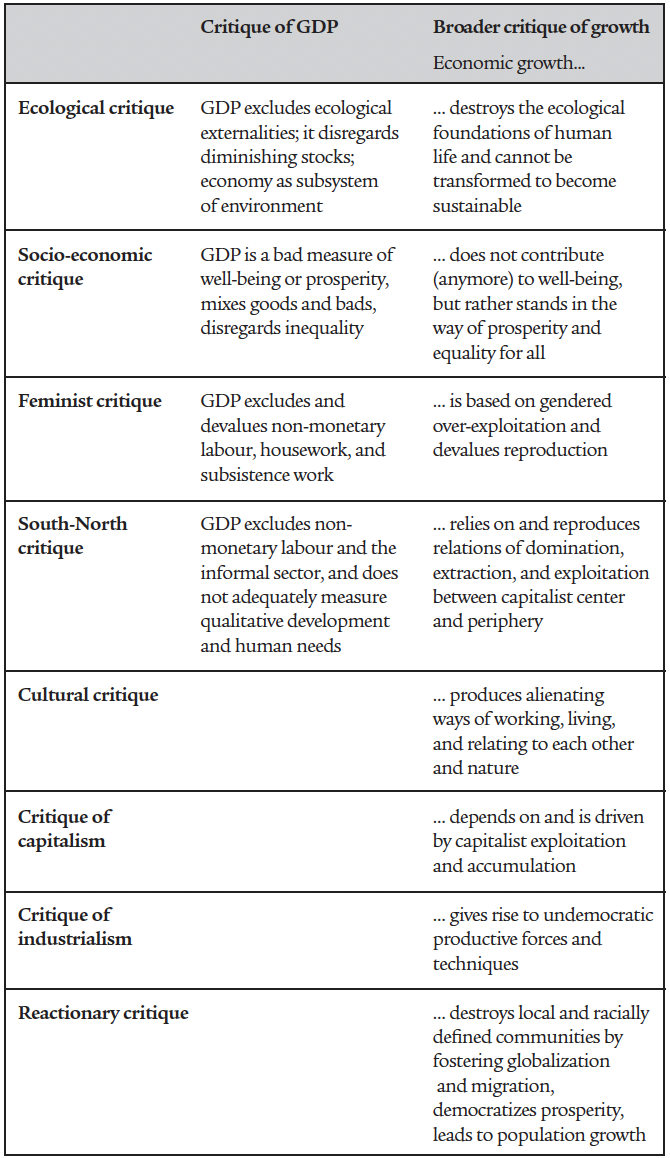
Table 6.1. Ideal-typical systematization of critique of GDP and economic growth. (Adapted from Schmelzer 2023).
Reactionary growth critiques, by contrast, do not primarily target capitalist accumulation or GDP growth. Instead, they argue that globalization, democratized consumption, and migration destroy racially or culturally defined communities and lead to population growth, which is then framed as the root cause of ecological degradation. From a political ecology and global justice perspective, such arguments displace structural drivers of crisis onto demographic processes and bodies, often reinforcing racist, exclusionary, and authoritarian responses. Since the 1970s, these neo-Malthusian positions have been supported by ecological think tanks such as Démographie Responsable in France, Population Matters in the UK, the Carrying Capacity Network in the United States, and Écopop in Switzerland.
Degrowth scholars have therefore consistently criticized population-centered environmental arguments as structurally racist and politically misleading, because they divert attention from affluence, capitalist accumulation, and systemic drivers of ecological breakdown (Parrique 2019; Hickel 2020; Schmelzer, Vetter, and Vansintjan 2022, 92–93). While degrowth does not oppose declining fertility per se when it results from autonomous and democratic social transformations, it rejects population control as a sustainability strategy grounded in external limits, rather than political agency (Kallis 2018, 181).
The Pitfalls of Population-Focused Politics
From the political ecology and global justice perspective outlined so far, population-centered environmental politics appear not only analytically limited, but also politically risky. While concerns about population are often framed as pragmatic or “realist,” they tend to obscure the structural drivers of ecological crisis and to legitimize exclusionary or authoritarian responses.
First, per capita production and consumption matter far more than population size. Extreme carbon inequality within and between countries renders the notion of a homogeneous “global population” analytically meaningless. The problem is not a population bomb, but a “lifestyle bomb”: the universalizing dynamics of the imperial mode of living, characterized by high-consumption infrastructures, rising expectations, and extreme inequality (Brand and Wissen 2021; Parrique 2019, 413–25). While the global population is projected to peak around mid-century, Intergovernmental Panel on Climate Change scenarios continue to model a world economy several times larger by 2100 (Hickel et al. 2021; Keen 2021).
Second, population discourse has historically been intertwined with racist, colonial, and patriarchal forms of governance, disproportionately targeting women and marginalized groups in the Global South (Connelly 2008). Third, population control is often ineffective and authoritarian, while societal changes often enabling declining fertility—reproductive rights and justice, gender equality, education, poverty reduction, and social security—are desirable independently of population arguments (Bashford 2014; Hartmann 2016). Studies even suggest contrary effects, that declining fertility increases ecological impact, because ageing societies with fewer children tend to use more average living space, with all the associated ecological impacts due to energy use and construction (Lamb et al. 2021). Finally, population is a slow lever of change. Given demographic inertia and the urgency of ecological breakdown, focusing on population offers little room for maneuver in the decisive decades ahead. Even extreme fertility policies would have only marginal effects on near-term emissions (Pont 2022).
Population-centered framings depoliticize ecological crises by shifting attention away from capitalist growth dynamics and toward externally imposed limits, reinforcing Malthusian imaginaries of scarcity, rather than democratic projects of collective self-limitation. Despite these pitfalls, the question of population cannot simply be dismissed. In the long term, providing good living conditions for all on a planet already shaped by centuries of capitalist expansion will become increasingly difficult under conditions of demographic growth. The central issue is how population can be addressed without reproducing authoritarian, racist, or depoliticizing logics that have historically accompanied population politics.
Toward an Emancipatory Politics of Self-limitation?
If population is to be addressed without reverting to neo-Malthusianism, the question of limits must be reformulated. Rather than treating limits as external, natural constraints that impose scarcity and demand demographic control, this section explores an alternative understanding of limits as collectively chosen projects of self-limitation. Drawing on political ecology, degrowth theory, and feminist histories of reproductive autonomy, the section develops a framework for thinking about population as a matter of democratic self-determination, rather than demographic management.
One possible avenue for such a reframing emerges from rethinking limits themselves. Drawing on Giorgos Kallis’s rereading of Malthus, sustainability scholars have argued that environmental politics too often rely on notions of external, natural limits that depoliticize ecological issues and legitimize exclusionary responses (Kallis 2019). In fact, environmentalist invocation of external limits—from neo-Malthusian framings in the 1972 Limits to Growth report to modern conceptions such as ecological footprint and planetary boundaries—risks falling into the Malthusian trap. The fixation on external, ostensibly “natural” limits defined scientifically, rather than on limits defined politically through democratic processes of self-limitation, entails the danger of turning environmentalists into prophets of doom, depoliticizing and scientizing ecological issues. Such framings can easily morph into arguments against migration and toward lifeboat ethics while reinforcing notions of scarcity that are functional for capitalism, which depends on scarcity and cannot operate under conditions of abundance (Kallis 2019, 62–66).
In contrast, degrowth does not understand limits as preexisting natural restrictions that impose scarcity, but as a political project of collectively desiring limits to growth in order to enable a good life for all. Degrowth is thus built around a fundamental democratization of the economy and the principle of collective self-limitation (Gorz 1989), understood as the collective setting of societal boundaries and entitlements that define the conditions of a good life for all. Collective self-limitation can be interpreted as a particularly strong expression of democratic autonomy: a form of societal self-government that liberates social life from the pervasive heteronomous logic of accumulation, which forces capitalist societies into continuous expansion and forecloses democratically determined collective rules. In this sense, self-limitation constitutes an expression of societal freedom or autonomy—the capacity of a collective to give itself its own rules—in direct opposition to heteronomy, understood as “the functional regulation of conduct according to given principles, such as the so-called law of the market or the mantra of austerity and growth” (Brand et al. 2021, 267).

Emma Goldman’s Mother Earth, Issue 1. Public Domain, via Wikimedia Commons.
Relating this perspective not only to production and consumption, but also to the reproductive sphere, degrowth scholars have drawn on feminist and anarchist neo-Malthusian traditions of the late nineteenth and early twentieth centuries. Figures such as Emma Goldman and her journal Mother Earth in the United States, Francesc Ferrer i Guàrdia in Spain, and Marie Huot, Madeleine Pelletier, and Paul Robin in France also referred to themselves as “neo-Malthusians,” but mobilized this label in a radically different way. They argued for birth control as a means of sexual, working-class, and feminist liberation, often explicitly linking reproductive autonomy to critiques of capitalism and ecological degradation (Masjuan 2000; Martínez-Alier 2024; Ronsin 1980).
These activists protested and organized (as suggested by the title of Francis Ronsin’s 1980 La grève des ventres) against natalist politics and the bourgeois order, which forced women into the role of mother against their will: to give birth to future workers, to serve elite interests, or to produce cannon fodder in imperial wars. Excessive population growth, they argued, pushed down wages and threatened the ecological conditions of human subsistence. In response, they advocated the use of contraceptives, free love, sexual liberation beyond reproductive imperatives, and the freedom of abortion (Ronsin 1980). For Goldman, in particular, limiting reproduction was not a technocratic intervention, but “a deliberate political action—a strategy against capital and its need for limitless growth” (Kallis 2021, 1).
Yet these feminist and socialist engagements with birth control were not insulated from the imperial geopolitics of their time. As Mytheli Sreenivas (2015) shows, some neo-Malthusian feminists and socialists in the late nineteenth century—most notably Annie Besant—mobilized birth control arguments through explicitly Malthusian readings of colonial poverty and famine, particularly in India. In these cases, population growth was framed as the primary cause of deprivation, while colonial extraction, land dispossession, and imperial political economy receded into the background. As Alison Bashford (2008) has argued, the strong focus on sexuality, reproduction, and women’s autonomy in feminist historiography risks obscuring these geopolitical dimensions of population discourse. Attending to these imperial entanglements is crucial, not in order to dismiss feminist neo-Malthusianism wholesale, but to underscore that population has always been a deeply geo-political question, articulated within unequal global power relations. This feminist neo-Malthusianism nevertheless stands in sharp contrast to the neo- Malthusianism that emerged from the 1970s onward, which promoted top-down, authoritarian, and often racist and misogynist forms of population control based on the assumption that population growth was the primary cause of poverty and environmental degradation. Whereas the latter treated population as a variable to be managed, the former constituted a bottom-up movement advocating “conscious procreation” through women’s freedom and autonomy (Martínez-Alier 2024, 676; Ronsin 1980).
The arguments for self-limitation advanced by Goldman and other feminist neo-Malthusians can thus serve as an important conceptual resource for contemporary sustainability debates. Their relevance lies less in specific demographic claims than in their political rearticulation of limits as questions of autonomy, care, and resistance. Read in conjunction with degrowth-aligned articulations of limits to capitalist imperatives of endless growth, feminist neo-Malthusianism points toward a global justice perspective capable of engaging with population in the twenty-first century without reverting to coercion or scarcity-based reasoning. In this sense, Donna Haraway’s (2016) call to “make kin, not babies” can be read as an invitation to decenter biological reproduction in favor of broader practices of care, responsibility, and more-than-human kinship—resonating with degrowth’s broader project of collective self-limitation.
Conclusion
This chapter has argued that population cannot be meaningfully addressed in the Anthropocene without situating it within the political economy of growth, inequality, and ecological degradation. From a political ecology and degrowth perspective, the primary drivers of unsustainability are not demographic trends as such, but capitalist economic expansion, extreme inequalities in production and consumption, and the global structures that sustain them. Population-centered environmental politics, therefore, risk misdiagnosing the causes of ecological crisis while legitimizing depoliticized, exclusionary, or authoritarian responses historically associated with population discourse.
At the same time, rejecting neo-Malthusianism does not require silence on reproduction. Instead, the chapter suggests that population can be approached in emancipatory terms only if the question of limits itself is reformulated. Shifting from notions of externally imposed natural limits to projects of collectively chosen self-limitation makes it possible to engage reproduction as a matter of democratic autonomy, care, and justice, rather than demographic management. Reframing population in this way redirects attention away from managing numbers and toward transforming the social relations that shape how societies produce, consume, reproduce, and care—beyond the imperatives of growth economies.