This chapter offers an account of meaning that can bridge the gap between humans and machines. It defines and exemplifies the key components of semiotic processes, shows the important role that values play in semiosis, and demonstrates how semiotic processes may embed and enchain. And, in preparation for the chapters that follow, it projects a simple functional notation onto human-specific semiotic processes so that they may easily be compared with those undertaken by large language models, and machinic agents more generally. In effect, I offer a noncanonical account of the grounds of interpretation, such that they may be extended past the limits of the human.
Components of Semiotic Processes
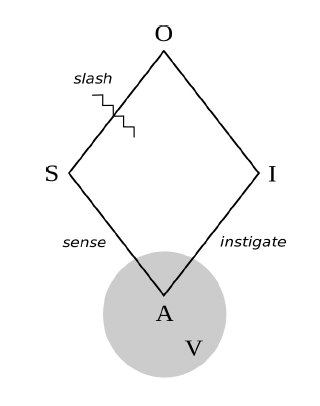
Figure 1. Semiotic processes
Figure 1 shows the key components of a semiotic process. Building on the ideas of Charles Sanders Peirce, the American logician and founding figure of pragmatism, a sign is whatever stands for something else. An object is whatever is stood for by a sign. An interpretant is whatever a sign creates insofar as it is taken to stand for an object. An agent is whatever can sense signs and instigate interpretants by way of relating to objects. Finally, values (which could also be called interpretative grounds or even guiding principles) are whatever an agent relies on to relate to signs, to relate signs and objects, and to relate objects and interpretants. Semiotic processes turn on motivation (what agents strive for) no less than meaning (what signs stand for).
Setting aside values for the moment, here are a few examples of semiotic processes. Someone (Agent) smells smoke (Sign), infers fire (Object), and calls for help (Interpretant). A telemarketer (A) hears the pitch of your voice (S), assumes you must be an adult male (O), and addresses you as “sir” (I). A student raises their hand (S), thereby indicating their desire to ask a question (O), and a teacher (A) calls on them (I). An interpreter (A) hears an utterance in French (S), which denotes a particular state of affairs and/or expresses a certain propositional content (O), which they then translate into German (I). Other examples include the exegesis of sacred texts, the diagnosis of illnesses, the undertaking of commands, the analysis of dreams, the explication of rituals, inferring a whole from a part, predicting subsequent events from preceding events, and far beyond.
In all of the foregoing examples, the interpretant makes sense in the context of the sign, given not just the interests (origins or identity) of the agent but also the features of the object (if only as imagined by the agent). As described in later chapters, the interpretant aligns with the sign insofar as it points toward the same object—however imprecisely.
While it is tempting to assume that objects are relatively objective and/or public (such as a tree that someone points to) and interpretants are relatively subjective and/or private (such as a thought or feeling), that is not necessarily the case. As these examples show, many objects are no more actual— and no less actual—than the desire one projects onto a person when they raise their hand; and many interpretants are as publicly available as signs, such as the German translation of the French sentence. And while many signs are communicative, insofar as they were intentionally expressed by an agent for the sake of securing an interpretant, the example of voice pitch highlights the fact that many sign-object relations—perhaps the majority—are nonintentional. The interpreting agent simply exploits (what seems to them to be) an existing correlation between a perceivable index and a putative identity.
“Each and every semiotic process contains its own horizon. ”
As these examples also show, a key feature of many semiotic processes is the fact that the agent only learns about the object through the sign: a cause is known by its effect; an intention is inferred through an action; a desire is intimated by a gesture; an identity is revealed through an index; an illness is disclosed through a symptom; and so forth. Loosely speaking, there is something like a slash that separates the sign from the object: what can be directly sensed by the agent is on one side; what can only be indirectly known (by means of the sign) is on the other side. Notice the little wavy line in figure 1. As will be seen in later sections, the key slash in machine semiosis is not that which separates speech acts from mental states or states of affairs (and hence separates language from mind or language from world, as stereotypically understood) but that which separates earlier parts of a text from later parts, and/or the past from the future.
In effect, each and every semiotic process contains its own horizon.
Values as Guiding Principles
Agents rely on a wide array of resources to engage in semiotic processes. To get from the sign to the object, they might rely on the rules and vocabulary of a particular language (e.g., French). They might rely on a certain understanding of causality (e.g., fire leads to smoke). They might rely on certain social conventions (e.g., a raised hand indicates a desire to ask a question). And they might rely on certain projected patterns (e.g., men usually have deeper voices than women). Moreover, to get from the object to the interpretant, they might rely on certain ethical commitments and economic rationales (e.g., one should be brave, houses are valuable). They might rely on certain social norms or strategies (e.g., strangers should be addressed politely, especially if one is hoping to make a sale). They might rely on the rights and responsibilities associated with particular social statuses (e.g., teachers are obliged to answer the questions of students, time permitting). And so forth.
More generally, semiotic agents rely on their knowledge of the grammars and lexicons of particular languages. They rely on felicity conditions (in the tradition of John Austin): shared understandings regarding the appropriate and effective use of language in context. They rely on their theories, intuitions, analytics, paradigms, imaginaries, hermeneutics, causal logics, epistemes, and worldviews. They rely on their taxonomies, partonomies, ontologies, schema, scripts, frames, stereotypes, prejudices, and biases. They rely on shared norms, rules, laws, conventions, protocols, and traditions. They rely on the affordances of various materials and/or the technological constraints of various media. They rely on their understandings of minds, signs, media, technology, language, nature, self, and society. They rely on morals, ethics, ideals, and evaluative standards. And, of course, they rely on context, cotext (meaning co-occurring text), and culture. Indeed, culture itself might be understood as relatively shared values, constituting something like the semiotic commons of a particular collectivity of agents.
Such interpretive resources, or values, are fundamental to semiotic processes. Understood as agent-specific sensibilities and assumptions, they function as guiding principles that allow agents to interrelate objects, signs, and interpretants. As such, they constitute the grounds of attention, affect, action, and inference. In particular, values help determine:
what an agent notices (such that it might constitute a sign in the first place);
what an agent infers or otherwise comes to know (given the sign so noticed);
how an agent acts, thinks, or feels (given the object so known).
Values may be encoded in texts; embodied in habits; enminded in beliefs and desires; embrained in neural networks; embedded in infrastructure, artifacts, and environments; and even engenomed in particular species. And many disciplines have long analyzed the genealogy of such values: the history of their creation, transformation, stabilization, and spread. In what follows, I will usually focus on values that are group-specific and historically changing and not be too concerned with their discipline-specific elaboration.
Although values often remain in the background of semiotic processes (which tend to be more noticeable figures, insofar as such processes involve relatively public actions and utterances), they can easily become figured. In particular, the objects of semiosis are often the values that guide semiotic processes: agents can topicalize, characterize, and reason about their values. In this way, agents can communicate and critique their own and others’ values.
Moreover, values are not only a condition of possibility for and the objects of semiotic processes, they are often the consequences as well as the ends of semiotic processes. Indeed, many interpretants are precisely changes in habits and beliefs, or values more generally, and hence changes in an agent’s propensity to interpretant future signs in particular ways.
In short, semiotic values are dynamic variables: at once the objects and interpretants, as well as the roots and fruits, of semiotic processes. As will be seen in the chapters that follow, they also play a decisive role in the machinic mediation of meaning.
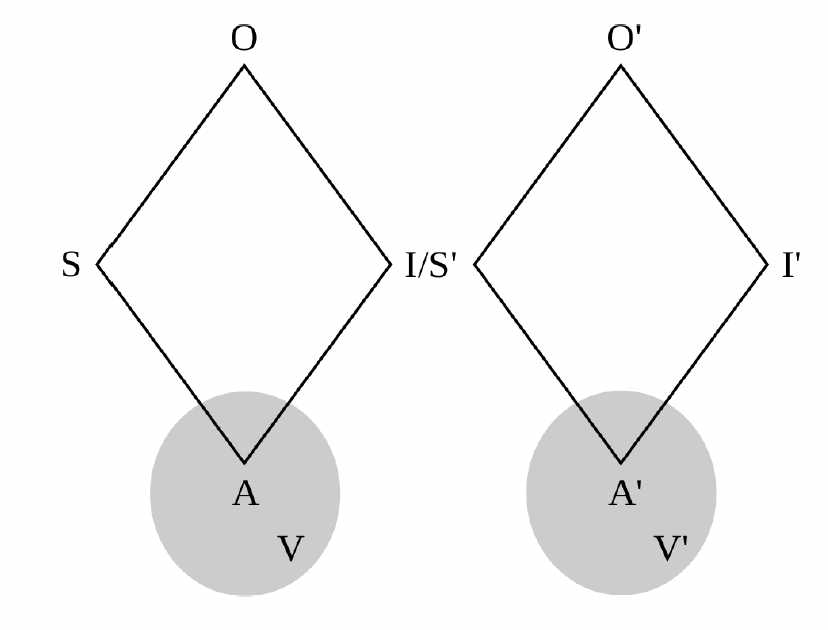
Figure 2. Enchaining
Apropos of the last set of points and looking forward to later arguments, I foreground two frequently occurring modes of semiotic mediation.
Figure 2 shows how semiotic processes may enchain: the interpretant in a prior process may constitute the sign in a subsequent process. For example, when a teacher calls on a student (as an interpretant of their having raised their hand), that itself also constitutes a sign (indicating that the student may now ask their question).
Such enchained semiotic processes constitute the backbone of everyday interaction and play a central role in mediating social relations. In particular, the relation between the sign and the interpretant (as two entities or events, with coupled relevance) mediates the relation between the signer and the interpreter (as two agents, with complementary and often emergent identities).
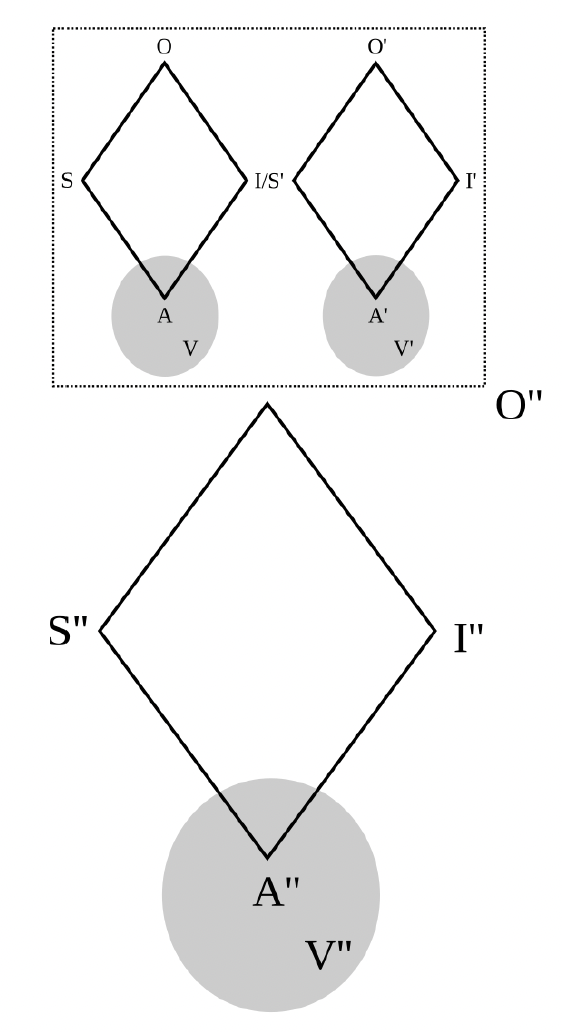
Figure 3. Embedding
Figure 3 shows how semiotic processes may embed: the object of a process may be constituted by any component of a process, any relation between such components, or any enchaining of semiotic processes more generally. To build on the previous example, another student in the class may later use reported speech, or even a stick figure cartoon with word balloons, to capture the interaction between the teacher and the student.
The values underlying semiotic processes are often the objects of semiotic processes: we can describe not just how the teacher responded to the student but also how they should have or could have responded. What we represent, and otherwise signify and interpret, is very often that which mediates our modes of signification and interpretation.
As a kind of shorthand going forth, it will sometimes prove useful to denote human semiotic processes in a quasi-functional notation:
I = AV(S)
Such a notation likens a human semiotic agent to a mathematical function, A. The input to this function is some sign, S; the output of this function is some interpretant, I; and the parameters of this function are the values of the agent, V. Compare a simple linear function like y = fθ(x) = mx+b, where x is the input, y is the output, and θ = {m,b} is a set of adjustable parameters that determine the slope and y-intercept of the line in question.
The point here is not to determine such a function, and certainly not to suggest that human semiotic agents are constituted by such a function (even if they may be modeled as one) but rather to condense all the dirty details of semiotic processes as they unfold in the wild, so to speak, in a compact notation for the sake of later comparison.
Humanists will, no doubt, be horrified. But I thought I might, in light of what comes next, meet the machines halfway.