On the Tuesday of Thanksgiving week, as every year, an American president will stand at the White House and spare the life of a turkey. The cameras will roll, the jokes will fly, and then the nation will sit down to eat tens of millions of the bird’s less fortunate cousins.
Why have a National Turkey at all? What does it mean to pardon one bird on television and then eat the rest? The ritual is less innocent than it looks, and more revealing than its organizers intend.
It is a sacrifice: a first-fruits harvest rite. The National Turkey stands on a table, is declared pardoned, and is let go (sometimes with a joke that earlier turkey pardons are void if signed with an autopen). The message is that we do not kill this bird, but leave its fate to God. Having performed this gesture, we feel entitled to eat the rest, as if we had atoned for our sins of killing other sentient beings. Sort of.
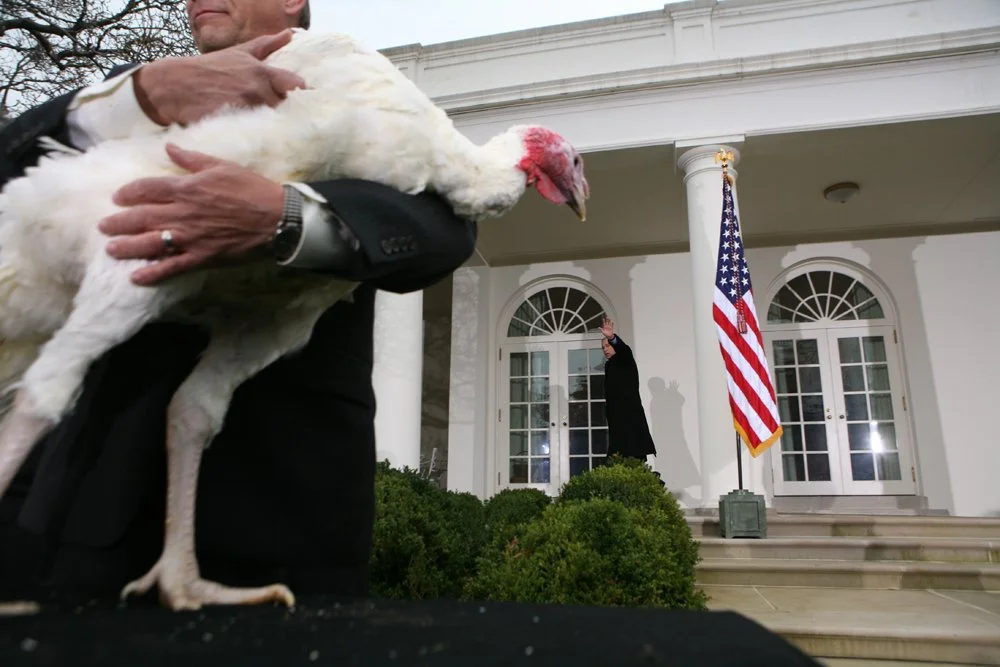
President George W. Bush Waves Farewell to Invited Guests Following the President's Pardoning of the Thanksgiving Turkey, 2006 (Wikimedia Commons)
But no ritual is innocent or, in this case, far from politics. The turkey pardon is not really about the bird. It showcases the president’s quasi-royal power over life and death: not only as commander in chief, who sends others to kill and die, but as pardoner in chief of his own people.
“The turkey pardon is not really about the bird. It showcases the president’s quasi-royal power over life and death: not only as commander in chief, who sends others to kill and die, but as pardoner in chief of his own people.”
And that power has rarely looked so royal. Presidents, like governors, may lawfully show mercy to people convicted for federal or State crimes by pardoning them. The politics of pardoning human beings haunts the ritualized spectacle of the turkey pardon. None of this is new: although earlier presidents informally pardoned turkeys, the institution tracks the ambivalent dream of an unfettered executive. And this year, a bumper crop of hard-to-explain pardons hangs over the turkey spectacle as never before.
News reports suggest a price tag running into the tens of millions of dollars for the pardon of one Venezuelan banker. Other pardons look nakedly political: the former president of Honduras, convicted of large-scale drug trafficking; the 1,500 people convicted over the Capitol attack of January 6, 2021, at least 97 of whom have since been convicted of new crimes. There is even talk of pardoning "everyone who has come within 200 feet of the Oval [Office]," and speculation that the president might pardon himself pre-emptively. That would be more than quasi-royal.
Amid the “No Kings” protests, it is worth being fair to kings: many ancient ones were elected and could be replaced if too corrupt. Much of modern history has been about discontinuing (or decapitating) kings, or binding them under constitutions.
Yet as the philosopher Giorgio Agamben has argued, even popular sovereignty must lodge the power of exception somewhere: over emergencies such as foreign aggression and war, and over mercy. Some democracies have domesticated the pardon, folding it into the judiciary as routine procedure. Tellingly, these are usually countries that have abolished the death penalty as incompatible with democracy.
That is no coincidence. Democracy rests on the recognition that there can be no certainty, least of all in matters of life and death. We are not gods. There can only be provisional agreements, not the kind of putative certainty that dictators, absolute kings and some preachers prefer.
Which brings us back to the turkey. This strange, uniquely American ritual is bound up with the lingering fantasy of certainty embodied in the death penalty.
“This strange, uniquely American ritual is bound up with the lingering fantasy of certainty embodied in the death penalty.”
That fantasy is under strain. A recent proposal to live-stream the execution of a former soldier was dropped amid public outrage, and the recent botched execution of Christa Pike raised fresh doubts about killing in the name of society — though not enough to abolish the death penalty, as most countries have. Like Iran and China, the U.S. clings to the delusion (nurtured by the “playful” turkey pardon) that there can be perfect decisions over life and death.
The current president is himself a longtime fan of the death penalty, even where the accused were exonerated and the real perpetrator found, as with the Central Park Five. That same faith in certainty can be found in his urging police to stop shielding suspects’ heads as they push them into squad cars. Because we know they’re guilty!
Yet the American justice system, like that of any decent country, rests on the key idea that certitude is elusive. The U.S. tradition of trials and juries owes much to the doubt of Judge Samuel Sewall, who helped wrongly convict the “witches” of Salem. He came to regret the hangings, and the crushing to death, of the victims, realizing that false certainty without evidence could never pass for the impartial rule of law.
Perhaps the turkey pardons will continue until the abomination of the death penalty is abolished. Perhaps that will also be the day the U.S. joins the 125 countries that have ratified the Rome Statute of the International Criminal Court. Until then, when the president spares a turkey this week, remember what is really on display. It is not mercy. It is the fantasy of unfettered power.
Click below to purchase and read Fiskesjö’s 2003 pamphlet!
Further readings
Fiskesjö, Magnus. The Thanksgiving Turkey Pardon, the Death of Teddy's Bear, and the Sovereign Exception of Guantánamo. Chicago: Prickly Paradigm Press, 2003.
Fiskesjö, Magnus. "The reluctant sovereign: New adventures of the US presidential Thanksgiving turkey." Anthropology Today 26.5 (2010), 13-18.
Francis, Richard. Judge Sewall's Apology: The Salem Witch Trials and the Forming of an American Conscience. New York: Harper, 2006.
