Introduction: The Spirit of the Dark Age
“I can tell you one thing after going all over the world. History is on our side. The globalists have no answers to freedom.”
—Steve Bannon to Errol Morris, American Dharma (2018)
“Who was so wild … [to think] that a party unheard of … with a self-chosen cognomen as ridiculous as satire itself could invent … would suddenly spring up … [and] absorb the elective strength of the state … ?”
—William Lloyd Garrison, The Liberator, 1854
Looking back from the end of the first year of Donald Trump’s second term in office, one can easily lose sight of how important Steve Bannon has been in giving shape and purpose to the Trump presidency. Bannon, a former Goldman Sachs investment banker and Hollywood film producer, cofounded Breitbart News as “the platform for the alt-right” in 2007, some years before the two men first met. His relationship with Trump over the past decade has been uneven, especially in respect to Trump’s erratic moves in foreign policy—never more so than with the attack on Venezuela. Bannon has also become increasingly outspoken about his own agenda, and his recruitment of Trump to it, in ways that have required some public distancing on Trump’s part. In late 2017, Trump fired Bannon as chief strategist at the White House, and there was a further public break in early 2018, when Bannon’s critical comments about Trump and his children were published in Michael Wolff’s Fire and Fury. Nevertheless, there can be little question that Bannon supplied an aggressively ideological program for a transactional candidate who notoriously lacked one, nor that, having become Trump’s “base,” the MAGA movement under Bannon’s leadership would push an agenda that included an attack on liberal institutions, especially American universities. The attack only grew bolder between Trump’s first and second terms in office.
One pivotal moment came in August 2016, when Bannon replaced Paul Manafort as Trump’s chief campaign strategist, though Bannon did not act alone in exerting such a mighty influence over the shape of things to come. A couple of weeks later, Bannon persuaded Trump to invite conservative activist David Bossie to join the team. Bossie, a longtime foe of Bill and Hillary Clinton, was the president of Citizens United, the organization responsible for the major deregulation of campaign financing in 2010 that helped set the stage for the current era in American politics. Bossie had earlier been party to the scheme to create the Willie Horton ads for George H. W. Bush’s successful 1988 election campaign, but Bush later filed a formal complaint against Bossie for producing “the kind of sleaze that diminishes the political process.” On October 7, 2016, a few weeks after Bossie joined Trump’s campaign, The Washington Post released the notorious Access Hollywood tape with its recording of Trump’s obscene boast about having his way with women.
Bannon and Bossie now had Trump where they wanted him. Trump needed to change the subject and up the stakes, as he has done many times since, not least in his protracted efforts to distract attention from the public outcry about the Jeffrey Epstein files. Less than a week after the release of the Access Hollywood tape, at a rally not far from his home base in Mar-a-Lago, Trump sounded the alarm about a vast international network of bankers whose ambition was nothing less than “to plot the destruction of U.S. sovereignty.” Shockingly, three weeks later—with the benefit of some questionable campaign tactics and a little late help from FBI Director James Comey—Trump won the presidential election, with Bannon and Bossie now very much in charge of his political agenda.
A partial explanation for this turn of events lies in a story that Bannon likes to tell about his early days with Trump, for by 2016, he and Bossie and Trump already had some shared history. Bannon’s story goes back to 2010, the year of the Citizens United decision, when Bannon and Bossie quickly formulated a plan for a wholesale renunciation of “globalism,” the now-familiar term of abuse for an ideological bogey man that, since the fall of the Berlin Wall, has come to replace international communism as a terrifying worldwide menace in the eyes of the far right. Other terms are sometimes joined to “globalists” to form disparaging epithets—“far-left globalists” or even “far-left globalist elites”—but they all amount to so many redundancies. As Bannon would later recount, his updated “America First” campaign involved three key elements: restricting trade, closing borders, and avoiding “forever wars.” But these three aspects of America’s relationship with the wider world—involving (respectively) commerce, immigration, and military policy—were bound up with key elements in a parallel campaign to transform American domestic policy.
“Independent sources of information and knowledge production—media outlets and universities—would have to be replaced or brought to heel. The goal of this last part of the domestic agenda was nothing less than a revolution in thought.”
Linked to the three-part mission to remake the place of the United States in the world was a further mission to intimidate, attack, and transform American institutions deemed to be implicated in the nefarious work of far-left globalist elites. All three branches of government would have to be controlled. The American legal establishment would have to be cowed. And, crucially, independent sources of information and knowledge production—media outlets and universities—would have to be replaced or brought to heel. The goal of this last part of the domestic agenda was nothing less than a revolution in thought. How to tell if news is real or fake, what counts as science, what it means to be educated—these would all become questions newly up for grabs. As the campaign has unfolded, the links between the domestic transformation and Bannon’s founding project have become ever clearer. Why push through the July 2025 rescission bill to remove funds already approved for NPR, PBS, and USAID? Mary Miller, MAGA member of Congress from downstate Illinois, explained her vote this way: “The days of Democrats’ taxpayer-funded propaganda and far-left global programs are OVER.”
Bannon may have become more frank in recent years about his ambitions, at some cost to his public relationship with Trump, but a decade and a half ago he clearly understood that he and Bossie could succeed only if they remained mostly behind the scenes. Only after Trump gained office did Bannon go public with his account of how he and Bossie came to identify a real-estate developer turned reality-TV celebrity as the perfect vehicle for advancing their ambitious scheme. He has explained that in 2012, the year after Trump had spoken at the Conservative Political Action Conference (CPAC) (and begun spreading rumors about President Obama’s birth certificate), he and Bossie met with Trump in Trump Tower. At one point, Bannon called himself “a populist,” a term Trump embraced (but repeatedly misheard as “a popularist”), and by the end of the meeting Bannon was telling himself that he might have found the front man for his great crusade. The cultivation of Donald Trump for this role had gone on privately for several years when, in November 2015, Bannon took their conversations public on Breitbart News. Hosting, and playing a wheedling “Steve” to his guest’s “Mr. Trump,” Bannon coached the presidential hopeful through a series of interviews on a range of subjects from China and Iran to oil and climate change. Anticipating the recent moves in Venezuela, Trump tells Bannon in that November 19 broadcast that the United States should be seizing oil around the world. We needed, he said, to “take it out and keep it.”
Trump and Bannon seem not yet to be on quite the same page in these interviews when it comes to so-called intellectual elites. In their first interview (November 5) they quibble about Bannon’s sarcastic reference to “smart Republicans”—Trump, failing to hear Bannon’s sarcasm, retorts that they are not smart but he (Trump) is. He even volunteers that he is keen to find a way to hold on to foreign students who “do great” at our best universities. One exchange in this broadcast stands out in Bannon’s later telling. As the talk turns, inevitably, to immigration, Bannon reports Trump as having said, “I still want people to come in. But I want them to go through the process.” Implying that he himself did not want people to come in, Bannon quotes himself (accurately) as replying: “You got to remember, we’re Breitbart. We’re the know-nothing vulgarians. So we’ve always got to be to the right of you on this.” There is something strikingly disingenuous in Bannon’s representation of his position on immigration as mere public posturing or political lane filling, as if it were not actually the position he strongly held and still holds. But the further interest of this remark lies in how Bannon makes the connection between policy and questions of knowledge: his self-identification with know-nothing vulgarians.
Here too Bannon is winking. His phrase “know-nothing” is something of an inside reference to the aforementioned Know-Nothing movement of the early 1850s, which took official political shape in 1854 as the American Party. This 2015 comment to Trump is not Bannon’s only invocation of this group and their ideological preoccupations. He has signaled more than once that he sees the Know-Nothing movement as an important point of orientation for his own massive ambitions, the full dimensions of which came dismayingly into focus in the first year of Trump’s second term in office. That 1850s movement, for all its brevity, was perhaps the most influential incarnation of the now all-too-familiar idea of “America First,” or what historians often call American Nativism.
It was not, however, the first expression of America First. There had been a brief moment of nativism in 1835, and another in 1844. Nor would it be the last. The 1920s saw a serious recurrence of what happened in the 1850s. “We have a great desire to be supremely American,” wrote President Calvin Coolidge in 1924. But the Know-Nothing movement of the early 1850s would eventually be recognized as having marked, and indeed enabled, a major pivot in antebellum American history. It helped both to end the old Whig Party in 1854 and to create the new Republican Party in 1856. Abraham Lincoln would be its nominee for president in 1860.
The Know-Nothing movement was initially launched as a secret society, the Order of the Star-Spangled Banner, in 1849, itself a successor to an earlier secret society called One United America, or OUA. The growth of this organization over its brief lifetime was nothing short of mind-boggling, from forty-three members to over a million between 1852 and 1854. The society extended to both the North and South of 1850s America, but it took a slightly different shape in each region. Common to both parts of the movement, however, was a fierce resistance to immigration targeted chiefly at the Irish and the Germans, and above all at the Catholicism that many of these newcomers to America brought with them.
In the decade from 1845 to 1855, more than a million people arrived from Ireland and an even larger number from Germany—ten times the immigration levels from these countries twenty years earlier. The new post-Famine waves of Irish immigrants were objectionable to some Americans in ways that earlier generations had not been—not only because of their numbers but also because they were more likely than ever to be Catholic. Compared with earlier arrivals from Ireland, these immigrants were less skilled and poorer, and included Gaelic speakers without English. In Northern cities they were seen as a cause of rising crime rates and a danger to employment opportunities for native-born Americans. “No Irish Need Apply” first appeared in a New York Times want ad in 1854. The Know-Nothings sought to combat the perceived threat, and their movement won so much support in its first year that it attracted myriad voters away from the old Whig Party and into the new American Party, albeit briefly.

John H. Gouter, Irish and Germans stealing elections, early 1850s. New York Public Library Research Collections
Other issues figured in this ideological mix, especially in the North. One was the question of temperance, so the party tended to incorporate attacks on the drinking habits of the Irish and Germans, with their rum and their beer.
More important was the issue of slavery. The American Party attracted former Whigs because the Whig Party was held responsible for two bills—highly unpopular in the North—aimed at appeasing the slaveholding South: the Fugitive Slave Act and the Kansas-Nebraska Act. It was evidently not inconsistent for evangelical and other Protestants from the North to detest Irish immigrants and oppose slavery at the same time.
For Lincoln, however, the case was otherwise. Writing to his friend Joshua Speed in 1855, he expressed his own views about the Know-Nothings in no uncertain terms:
I am not a Know-Nothing. That is certain. How could I be? How can anyone who abhors the oppression of negroes, be in favor of degrading classes of white people? Our progress in degeneracy appears to me to be pretty rapid. As a nation, we begin by declaring that “all men are created equal.” We now practically read it “all men are created equal, except negroes.” When the Know-Nothings get control, it will read “all men are created equal, except negroes, and foreigners, and catholics [sic].” When it comes to this I should prefer emigrating to some country where they make no pretence of loving liberty—to Russia, for instance, where despotism can be taken pure, and without the base alloy of hypocracy [sic].
As things turned out, the American Party’s opposition to slavery was both fainthearted and short-lived. The party nominated former President Millard Fillmore at its 1855 convention and then came undone when delegates from Southern states pushed through a proslavery platform unacceptable to delegates from the North. After the Supreme Court’s Dred Scott decision refusing citizenship to people of black African descent, most antislavery members of the American Party joined the Republican Party that Lincoln would soon be leading.
One glaring irony in Bannon’s invocation of the Know-Nothing movement as background for his and Trump’s crusade has to do with their respective ancestries. Trump is a descendent of German immigrants and Bannon a descendent of Irish-Catholic immigrants. Trump’s grandfather, Friedrich, arrived in the United States from Bavaria in 1886 with just a suitcase. Bannon’s great-grandfather, Lawrence Bannon, came over from Ireland in 1850, squarely in the middle of the same post-Famine mass exodus that triggered the rise of the Know-Nothings. Bannon’s great-grandfather himself would thus presumably have suffered some persecution in the 1855 heyday of the movement, when Know-Nothing candidates held 140 seats in the House and Know-Nothing mayors were elected in Chicago and major cities across the northeast.
Indeed, had the Know-Nothing movement triumphed more completely and more immediately, Bannon’s great-grandfather would not have been able to enter the United States when he did, or perhaps ever—there would be no Steve Bannon from Richmond, Virginia, to recruit Trump as the political face of his plan to close American borders. Unsurprisingly, in his own time Bannon has run afoul of the Catholic Church for suggesting that American bishops’ public support of Deferred Action for Childhood Arrivals (DACA)—the immigration policy extending citizenship to the “Dreamers”—was just a way of filling empty pews. On November 12, 2025, in response to the aggression of Trump’s immigrant crackdown and the rhetoric that supports it, the American bishops issued a strong statement condemning “the vilification of immigrants,” defending their contributions, and affirming that Catholic teaching “exhorts nations to recognize the fundamental dignity of all persons, including immigrants.”
I distinctly remember first encountering the Know-Nothing movement in a U.S. history course offered at my Catholic high school. It was a matter of particular interest, and its name was amusing to the adolescent mind. But the movement of the 1850s was not initially conceived as a celebration of ignorance. The manifestos produced on behalf of Know-Nothingism stake their intellectual claim in home-grown American Protestantism. A strong evangelical strain informed the Know-Nothing constituency: a firm commitment to understanding the world through Holy Scripture and to ensuring that the King James Bible, and no other, would be taught in public schools. But the Bible itself had to be read, after all, and Know-Nothings did promote literacy.
Among the more bookish adherents of the cause was James Harper, the cofounder of the great New York publishing house, who was elected mayor of that city on the American Party ticket in 1855. J & J Harper made its early reputation (and fortune) on the back of a rabidly anti-Catholic, anti-immigration novel of 1836, Maria Monk’s Awful Disclosures, about a young woman abused by nuns in a convent. This novel sold hundreds of thousands of copies and eventually earned a reputation as a nativist Uncle Tom’s Cabin. Like Stowe’s, this book offered itself as enlightened critique, not as deliberate obscurantism. The word “Enlightened” appears often in Know-Nothing writings of the 1850s.
The Know-Nothing label, historians speculate, may have derived not from the movement’s resistance to enlightened understanding as such, but rather from responses given by members of the secret society who, when asked about their organization, were supposed to have said: “I know nothing.” In a modern Irish context, this evokes the famous line in Seamus Heaney’s poem about the IRA: “Whatever you say, say nothing.” And yet it seems that the Know-Nothings, though they preferred to be identified with the American Party, themselves sometimes employed the seemingly unflattering epithet for their projects. As Tyler Abinder, the leading historian of the movement, has pointed out: “One of the first newspapers to support the new movement was entitled the Boston Know Nothing, and even in 1856, the organization continued to call its political yearbook the Know Nothing Almanac” (Nativism and Slavery: The Northern Know Nothings and the Politics of the 1850s [1992], 14).
Richard Hofstadter noted in The Age of Reform (1955) that the Know-Nothing movement was “based almost entirely on conspiratorial ideology,” and thus in a series of American political movements for which the through line was not so much ignorance and unreason as fear and hate. When Hofstadter returned to the Know-Nothings in Anti-Intellectualism in American Life (1963),he told the story this way:
There has always been in our national experience a type of mind which elevates hatred to a kind of creed; for this mind, group hatreds take a place in politics similar to the class struggle in some other modern societies. Filled with obscure and ill-directed grievances and frustrations, with elaborate hallucinations about secrets and conspiracies, groups of malcontents have found scapegoats at various times in Masons or abolitionists, Catholics, Mormons, or Jews, Negroes or immigrants, the liquor interests or the international bankers. In the succession of scapegoats chosen by the followers of this tradition of Know-Nothingism, the intelligentsia have at last in our time found a place. (37)
Still, some historians do link Know-Nothingism with the populism that preceded it (Mark Voss-Hubbard, Beyond Party). This populism already had a recognizably anti-intellectual component in the early nineteenth century, as early liberals like Alexis de Tocqueville and John Stuart Mill pointed out at the time. I discuss some implications of Trump’s turn to Jacksonian populism in section 5.
But why would the Know-Nothings embrace a term that sounds so much like a slur? Perhaps they were rejecting a certain kind of knowledge: cosmopolitan, global, and, of course, anything pertaining to the Roman Church. International Catholicism in the 1830s was the forerunner of the twentieth-century specter of international communism bent on global domination, and perhaps also the twenty-first-century specter of Islam, which Bannon often singles out as another global threat to his notion of the American way of life. Certainly, Bannon’s own references to the movement show that he is aware of the implications of the term “Know-Nothing” beyond the closing of ranks in a secret organization. He himself has made the connection between his own anti-immigration campaign and what one might call “the question of learning” with remarks like his 2012 comment to Trump about how the Breitbart team needs to represent itself publicly as “the know-nothing vulgarians.” When Bannon first announced the launch of his daily talk show on Breitbart in November 2015, the very month he began featuring interviews with Trump, he declared that its programming was for “those ‘low information’ citizens who are mocked and ridiculed by their ‘betters’—the clueless elites.”
The scare quotes around “low information” might seem to suggest irony, but this is not the Socratic irony implicit in the philosopher’s famous declaration that he knows nothing, the kind of irony that has long informed discussion in the liberal arts classroom. In explaining himself on this occasion, Bannon went on to flatter his audience as “the most hungry for news, information, and analysis on the web.” Yet in his latest programming enterprise, the Bannon’s War Room podcast (launched in October 2019), all traces of an educational mission have fallen away, along with any pretense of journalism. In an interview with The New York Times’s David Brooks (July 1, 2024), Bannon explained: “I’m not a journalist. I’m not in the media. This is a military headquarters for a populist revolt. This is how we motivate people. This show is an activist show. If you watch this show, you’re a foot soldier. We call it the Army of the Awakened.”
Bannon’s representation of himself as a nonelite—in public posture and also, for instance, in his mode of dress—can hardly be taken seriously considering his degrees from Harvard and Georgetown, his work at Goldman Sachs, and his time in Hollywood managing media mergers. Among his other ventures, he has profited greatly from Seinfeld reruns. But the implications of the military metaphors he now regularly deploys are clear enough. The time for knowledge—for “information” and “analysis”—seems to have passed. Foot soldiers don’t ask questions. They take orders. Bannon, who calls his website “a killing machine,” is their general, the leader of the new Know-Nothings.
Bannon is a nationalist who regularly boasts that he travels the world shoring up other countries’ right-wing nationalist leaders: Viktor Orbán in Hungary, Marine Le Pen in France, Giorgia Meloni in Italy. But he does not identify his enemies in this so-called war in nationalist terms—Russia, say, or Iran, or China. No, the real enemies are those “clueless elites” whom Bannon contrasts with his own foot soldiers: the globalists, the Know Somethings. Journalism itself—typically branded as the “left-wing,” “mainstream” media—is one bastion of the Know Somethings. But the citadel of the enemy realm, the institution that must be toppled, is the American university. This siege will be undertaken not in the name of enlightenment but in the name of an all-out war. The old right-wing challenge against universities—that professors and students were pursuing activism, not knowledge—has been turned on its head. Bannon makes no bones about it. Xenophobic America-First Know-Nothingism is sheer activism—and what Bannon calls his “war” is just activism by other means.
Today’s Know-Nothingism comes in many forms, and accordingly, Trumpian authoritarianism serves plans and schemes beyond those of Bannon and ongoing Trump favorite Stephen Miller. These range from Project 2025 (produced by the Heritage Foundation) to the pilot takeover of education staged in Florida by Governor Ron DeSantis and conservative activist Christopher Rufo, and the many provocations of the Israel lobby, including its evangelical wing at the Esther Project. Not all these proponents emphasize exactly the same aspects of Know-Nothingism that animate Bannon’s army. Nor are they all as open as Bannon about what they are up to and why. Bannon’s forthrightness as a semi-outsider singles him out, and that is surely why he has become so popular on the interview circuit in recent years—not least in the extended conversations of Errol Morris’s feature-length documentary, American Dharma (2018), a must-see for anyone seeking to come to terms with the spirit of our dark age.
Precisely because Bannon is so forthcoming about his ideas and ambitions, his contradictions are everywhere apparent. He is an avowed “economic nationalist” who claims to be taking action on behalf of people who have been left behind in recent decades. Yet he staked his movement on a billionaire whose tax policies have most benefited those in his (and Bannon’s) own oligarchical circle. He is an avowed populist who declares he’d rather see the country governed by the first hundred people in MAGA hats to come through the door in a Trump rally than by the “scientific, engineering, and globalist elites” who have been in charge for too long. Yet he supports the authoritarianism of a president willing to call his most loyal followers “weaklings” if they ask the wrong questions.
Even more to the point, Bannon conceives his role in the movement as a leader who demands blind obedience from his “men.” He might praise the wisdom of those he claims to have turned into a virtual community on his website, yet at the point of mobilization, which can never come too soon for him, all that matters is their whipped-up rage. Bannon will eagerly assert that “the key to these sites [like the War Room] was the comment section.” But the comment section is not a curation of deliberated opinion aimed at the best possible judgment and course of action. The goal from the start was to see opinion “weaponized at some point in time,” because the “angry voices, properly directed, have latent political power.” The direction comes from General Bannon, who is not to be questioned—and who now boasts of having taken his antiglobalist campaign worldwide. On the day he reported to prison, July 1, 2024 (for four months, convicted of mail fraud and money laundering in the “We Build the Wall” fundraising campaign), Bannon told the BBC that he “was unconcerned about missing a crucial part of Trump’s campaign, as there is a ‘Maga army’ ready to ensure the former president defeats Joe Biden.”
In view of such ambitions and the conditions of politics and culture they demand, it is no surprise that in Trump’s second term, even more aggressively than in his first, he and his team have relentlessly attacked the liberal—in the sense of deliberative—institutions of modern society: the free press, the rule of law, and the modern university. There is no place in an authoritarian world order imposed with rage and enforced through fear for the kind of open discussion and reflection that such institutions both depend on and promote. The resort to intimidation, especially in the second term, is precisely what has caused so many anxious observers to speak of an encroaching fascism in this country and to look for a precedent to Germany in the 1930s—or even America in the 1920s. One such observer is Yale-educated J. D. Vance, who in the lead-up to the 2016 election likened Trump to a second Hitler. But this was before he was persuaded that this second Hitler might help his political advancement. Nowadays he likes to claim, as many fascists have done over time, that “professors are the enemy.”
Neo-Nazism came to the fore in the events of August 2017 in Charlottesville, and the first Trump administration was notoriously slow to condemn it. Bannon himself was initially reported to be a casualty of that episode, though Trump had apparently been contemplating his ouster earlier, after reports surfaced about Bannon’s taking credit for the election victory. Bannon has always protested that he is not a white nationalist, that his movement has no room for neo-Nazis—and that he is neither antisemitic, as his first wife alleged, nor a racist, as the Southern Legal Counsel charged. On other occasions, however, he has instructed his followers not only to accept epithets like “racist” and “nativist” but also to “wear them like a badge of honor.” Most important, he does little to discourage the connection with the original Know-Nothings, and perhaps ultimately with the war they waged on Irish immigrants.
Besides nineteenth-century media mogul James Harper, another prominent member of the Know-Nothing party in the New York of the early 1850s was William “the Butcher” Poole, whose violence against Irish Catholics was memorably restaged on screen by Daniel Day-Lewis in Martin Scorsese’s 2002 Gangs of New York. Perhaps even more than Harper, who was after all politic enough to become Mayor of New York, Poole represents an ironic nineteenth-century exemplar for Bannon’s new Know-Nothingism. As the brutal leader of the Bowery Boys, he assumed the role of a gang lord hell-bent on blocking immigrants and extirpating Roman Catholic globalism. Though he left little by way of a written record, an 1853 notice in the Brooklyn Eagle notes a William Poole elected to serve a three-year term in the sixth ward of New York City’s Board of Education. This would make a degree of sense, since so many of the Know-Nothing movement’s issues centered on the question of exactly what was being taught in schools. But if this was indeed the William Poole, as seems likely, he would have been responsible for shaping the educational experience of students in New York schools in the decade after the arrival of Lawrence Bannon from Ireland. I can find no information about whether Steve Bannon’s great-grandfather came first to New York, like so many other famine immigrants did. But the thought of him under the tutelage of Daniel Day-Lewis’s William Poole character in Gangs of New York is an image to reckon with.
Another Catholic immigrant of this moment, Thomas Nast, who definitely did attend New York City schools in the 1850s, would go on to become the greatest political cartoonist of his age. Nast was born in Bavaria in 1840 and came to the United States as part of the same Irish and German waves of immigration that the Know-Nothing movement was created to oppose. Nast’s career was well advanced by 1870, when he produced a cartoon about how American attitudes to immigration were evolving. Once the Germans and Irish Catholics assimilated, many of them in their turn struck a hardline anti-immigration stance toward new Chinese arrivals. Recognizing this irony led Nast to one of his most famous and prophetic satirical efforts: “Throwing Down the Ladder by Which They Rose.” Atop the newly walled border around the United States, under an updated Know-Nothing flag, stand assimilated Irish and German Catholic immigrants. They are led by President Patrick and Vice President Hans, presumably Irish and German leaders of the new Know-Nothings, a reincarnation of the very movement that had so relentlessly persecuted them, or their parents, a quarter of a century earlier.
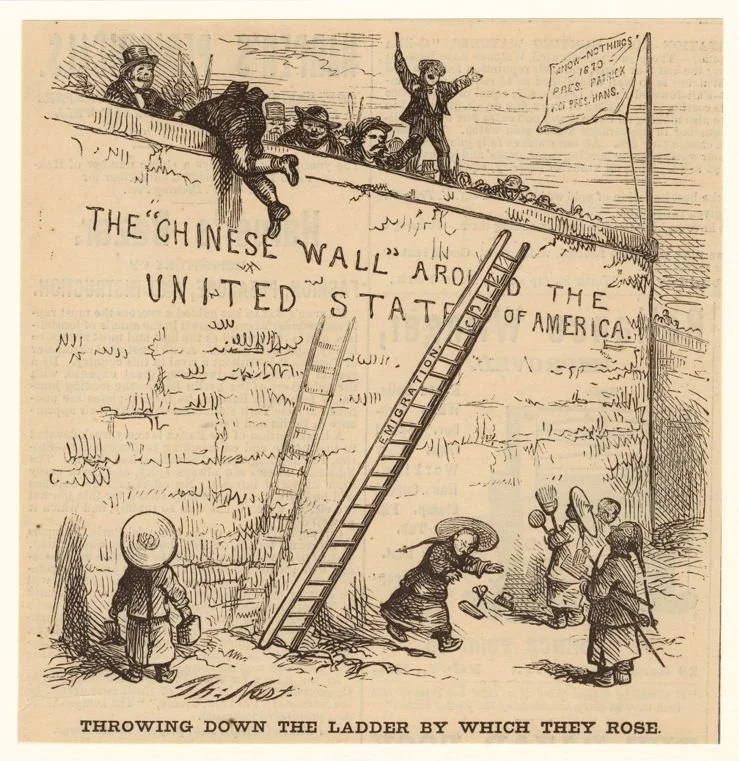
Thomas Nast, “Throwing Down the Ladder by Which They Rose,” Harper’s Weekly, July 23, 1870. New York Public Library Digital Collections.
Nast was one contemporary who associated the Know-Nothing movement not just with xenophobia but also, taking the name at face value, with ignorance. Yet his satirist’s instincts led him to a figure and a fact that has persisted over decades and perhaps never been more resonant than today. It is hard to look at this 1870 cartoon without thinking of the Irish American president of Breitbart News and the German American president of the United States. More is involved here than mere policy. Beyond reviving the same kind of Know-Nothing immigration proposals that would have kept their own ancestors out of this country, Steve Bannon and Donald Trump have also supported their effort with the same kind of illiberal xenophobic rhetoric that the nineteenth-century Know-Nothing movement used to stoke that first campaign.
Nast’s cartoon represents a case of “situational irony,” understood as a certain turn or “twist” of events in which circumstances invert what we might reasonably have expected: the fire in the fire station. Situational ironies abound in our dark moment, and each of the sections that follows attends to at least one of them: a neofascist takeover masked as a crusade against antisemitism in universities; a major player from the murky world of professional wrestling in charge of education policy; a government crackdown on major media outlets carried out in the name of free speech; a narcissistic president who governs by greed and whimsy touted as a strategic genius; a thought that we might do without the combined advantages of liberal education and the research university that have, ever since Tocqueville’s and Mill’s liberal critique of Jacksonian America, constituted a principal source of her strength.
But another way irony matters here lies not as much in circumstances as in our response to them. This is irony as trope or device, a discursive twist of tone or implication often associated with the genre of satire. In addition to identifying situational ironies, I look at ironic responses to them in satirical practice across media. Following the insightful offbeat Irish commentator Blindboy Boatclub, however, I also show how Trump and his team have attempted to use Know-Nothing tactics to inoculate themselves against the effects of satire—not least in adopting the modus operandi of that world of professional wresting in which not only our Secretary of Education but also the President himself have been such important figures over the years. Linda McMahon was, along with her husband, Vince, cofounder of World Wrestling Entertainment (indicted for distributing steroids to his wrestlers), and Trump is an official member of its Hall of Fame.
The WWE is not to be confused with the UFC (United Fight Club), the martial arts group Trump will host for a series of bouts on the White House Lawn as part of the country’s 250th anniversary celebrations in 2026. Trump would of course prefer to cast himself as a martial arts combatant, but he is better understood as a performer in the pre-scripted drama of the wrestling ring, where egregious buffoonery mixes the roles of the hero and the “heel.” The world is governed by the conventions of “kayfabe,” a way of blending illusion and reality, the playful and the serious, that the great French critic Roland Barthes has accurately described as offering “a spectacle without thought.” Kayfabe might be considered the antithesis of what the philosopher Richard Rorty has called “liberal irony,” a Socratic capacity to look at a situation from many thoughtful perspectives at the same time—not to be confused with the deeper existential condition that the late Jonathan Lear found in Kierkegaard’s version of Socratic irony. Kayfabe asks that we accept the spectacle offered without having any thoughtful perspective at all, a demand that makes it the perfect expression of the new Know-Nothing movement.
Bearing in mind, then, that satire has become a particularly crucial response to illiberal unknowing in our time, I will leave the final word on Bannon and his immigrant great-grandfather to the brilliant comedian Trevor Noah, himself an immigrant to America (from South Africa). After hearing Bannon’s criticisms of DACA in a 60 Minutes interview back in 2017, Noah did a little research and learned the facts about Bannon’s ancestry. Here is how he reported his findings to the audience of The Daily Show, a television show he succeeded Jon Stewart in hosting:
“Lawrence Bannon, arrived in the U.S. from Ireland by the 1850s, at a time when America’s borders were so open that Irishmen could walk into the country with no passports, no visas, no background checks of any kind.” Noah continued, “So in many ways, Steve Bannon’s great-grandfather was a DREAMer.
“Yeah, and his great-grandson is a f***ing nightmare.”