2. A Spectacle Without Thought
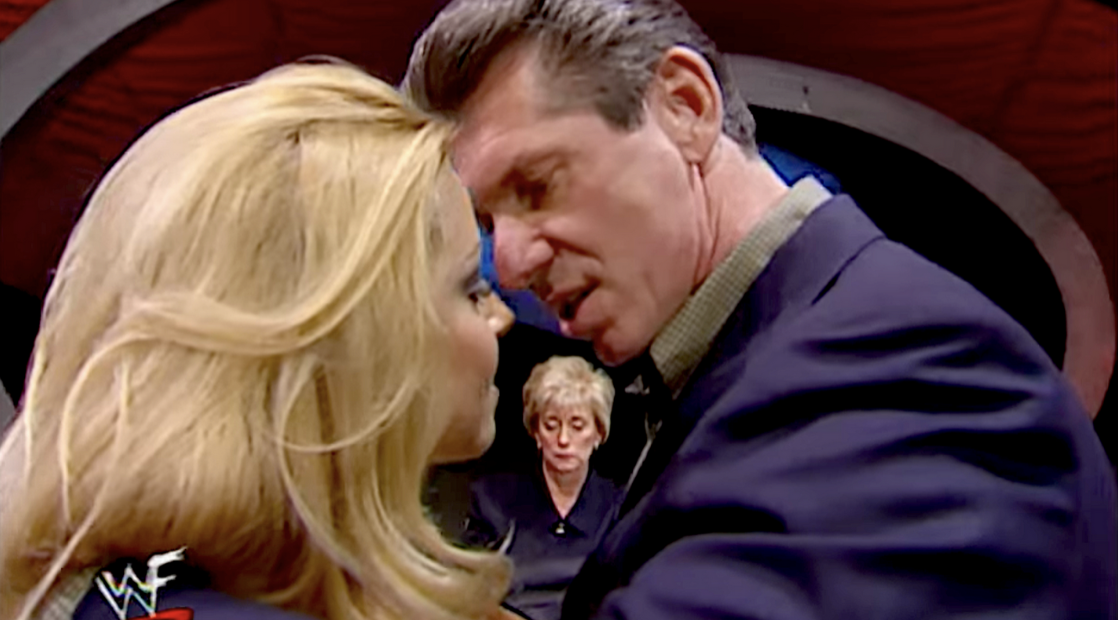
Trish Stratus and then-WWE President Vince McMahon, with his wife, Linda McMahon, in the background, WWE Smackdown event, May 3, 2001. https://www.youtube.com/watch?v=zQ0bGm82q0k
In an escalation of both its attack on higher education and its crackdown on dissenting opinion in this country, the Trump administration announced in May 2025 that it was suspending interviews for international student visas until it had the capacity to screen applicants’ social media for content it considered politically objectionable. After the process was restarted a month later, applicants were required to make their social media accounts public, and consular officers were instructed in the broadest of terms to look for “any indications of hostility toward the citizens, culture, government, institutions or founding principles of the United States.” So the many foreign students who have expressed concerns about U.S. support for the war in Gaza might well be out of luck.
Like so many such news items in the first year of Trump’s second administration, this development was deeply troubling and yet sadly predictable. It was entirely in line not only with the administration’s recent power moves but also with its not-so-subtle signals of what to expect next. Some of those moves had been made in the high-profile fight that the administration picked with Harvard University—and may be in violation of Title VI rules and the First Amendment principles they claim to be defending. Likewise, some of the signals were generated in the course of the same public campaign.
Consider the letter that Secretary of Education Linda McMahon sent to Harvard’s president, Alan Garber, on May 5, 2025, which begins:
The Federal Government has a sacred responsibility to be a wise and important steward of American taxpayer dollars. Harvard University, despite amassing a largely tax-free $53.2 billion dollar endowment (larger than the GDP of 100 countries), receives billions of dollars of taxpayer largess each year. Receiving such taxpayer funds is a privilege, not a right. Yet instead of using these funds to advance the education of its students, Harvard is engaging in a systemic pattern of violating federal law. Where do many of these “students” come from, who are they, how do they get into Harvard, or even into our country—and why is there so much HATE? These are questions that must be answered, among many more, but the biggest question of all is, why will Harvard not give straightforward answers to the American public?
McMahon’s opening words reveal both a pivot away and a broadening out from the line of attack that the administration had taken against Harvard and other universities in previous weeks. That attack had mobilized charges of antisemitism on behalf of its quasi-fascist effort to intimidate and control institutions of higher learning. Partly because of the rise of Jewish voices against this tactic, the administration evidently saw fit to reframe the charge against Harvard for the purposes of the May 5 letter. The charge now became nothing less than “a systemic pattern of violating federal law.”
And yet, in lieu of spelling out the meaning of this grave and sweeping allegation, McMahon raised a series of insinuating “questions” that suggest that something must be rotten in Harvard’s attractiveness to foreign students. Her questions portended that shocking but predictable measure to suspend all visa interviews until the thought police could ramp up their surveillance capacity.
Most remarkable of all about McMahon’s opening paragraph, however, is the question that comes last, after all the sanctimony (“sacred responsibility”) and insinuations. It comes after a dash, and almost as an afterthought: “and why is there so much HATE?” There is much to say about this big little question and how it functions in McMahon’s machinations against Harvard. The use of all caps is a gesture to the typographical style of the president; but more to the point, what is the sphere of reference? The question seems to imply something like: “Why is there so much HATE there?,” at Harvard. But as posed, it seems to sound a more general and open kind of concern, like the puzzlement of someone for whom hostility and animus are just mysterious, alien forces in the world. Why can’t we all just get along? What the world needs now is love and understanding. Why can’t the hateful people at Harvard understand that? And why don’t they answer a simple question when it is put to them? What are they hiding?
The irony implicit in an apparently simple question worded just this way, on this occasion, by such a person is worth pausing over. First, although to Harvard, the question is really—like the information that Harvard’s endowment exceeds the GDP of 100 countries—intended for another audience, the world of social media where McMahon’s letter was posted and reposted by the likes of Daniel Scavino, Trump’s Deputy Chief of Staff, to cheering responses in the MAGA world. McMahon’s “critique” of Harvard in these circles was called scathing, blistering, and, above all, well-deserved. Harvard, said the MAGA world, has had this coming for a long time. As for the Pollyanna-sounding tone of the question, some of the more tuned-in MAGA observers would certainly have relished the thought of such sanctimonious posturing, and indeed such false naïveté, coming from Linda McMahon. For the larger irony of this confrontation lies in the fact that McMahon, a cofounder of World Wrestling Entertainment, along with her indicted husband, Vince, should be Trump’s point person on this matter in the first place. Indeed, the WWE is an enterprise that supplies multiple frames of reference for understanding the deeply cynical worldview shared by the McMahons and their intimate friend in the White House.
In 2013, Donald Trump was inducted into the WWE Hall of Fame. He was introduced that evening by Vince McMahon, with whom he had what he described in his acceptance speech as “an amazing relationship for many years” that, as he recalled wistfully, went back to WrestleMania IV in Atlantic City in 1988. Trump also recalled that, for WrestleMania XXIII in Detroit in 2007, he and McMahon had staged the “Battle of the Billionaires.” This event turned on a “bet” about the outcome of a staged wrestling match, with the loser, in this case McMahon, getting his head shaved in the ring by the winner. A “struggling” McMahon was pinned down by a “referee,” then covered with shaving cream and shorn by Trump with an electric razor. In claiming his place in the WWE Hall of Fame, Trump boasted, unsurprisingly, that WrestleMania XXIII had the largest pay-per-view audience in wrestling history. The video of the bizarre episode, with the billionaires scuffling awkwardly in expensive Italian suits, was in circulation before the 2016 election, and I remember thinking, foolishly, that if only more people saw it, Trump would be unelectable. If anything, it probably helped his cause.
In advance of WrestleMania VII, held at the Los Angeles Sports Arena in 1991, Sports Illustrated (March 25) produced a feature-length article about McMahon’s transformative effect on professional wrestling. It began with a long verbatim quotation from the opening of what it called a “famous essay” by the great French critic Roland Barthes, “The World of Wrestling,” the first piece in his 1957 collection Mythologies, probably the most widely read of his many books:
The virtue of wrestling is that it is the spectacle of excess. Here we find a grandiloquence which must have been that of ancient theaters. […] Even hidden in the most squalid Parisian halls, wrestling partakes of the nature of the great solar spectacles, Greek drama and bullfights: In both, a light without shadow generates an emotion without reserve.
And this, as Sports Illustrated staff writers put it, “brings us directly to WrestleMania VII. For in the latest of the World Wrestling Federation’s annual editions of mad, mad, mad myths-on-a-mat, we will indeed experience another spectacle of excess.” When the writers close their piece with a final tribute to McMahon by way of Barthes’s suggestion that professional wrestling briefly “unveils the form of a justice which is at last intelligible,” they miss or suppress the irony laced into Barthes’s point about the kind of justice that stands thus revealed.
“ Back in 1957, Barthes had been forceful in making what was for him a key distinction: “There are those who think that wrestling is an ignoble sport. It is not a sport; it is a spectacle.” He had, in effect, provided an analysis of what is known in the WWE as “kayfabe.””
There is, however, a further connection between Barthes and Vince McMahon that the Sports Illustrated article did not spell out. One of Barthes’s claims in “The World of Wrestling” was effectively the same one that the McMahons had used in their 1989 effort to reduce their tax burden by redefining what was then called the World Wrestling Federation as promoting a nonsport. They would later change the name to “World Wrestling Entertainment” to reflect this. Back in 1957, Barthes had been forceful in making what was for him a key distinction: “There are those who think that wrestling is an ignoble sport. It is not a sport; it is a spectacle.” He had, in effect, provided an analysis of what is known in the WWE as “kayfabe,” long before the term was coined in the 1980s to name the governing convention of openly shared illusion that makes professional wrestling the kind of show it is.
Along with Trump, one of the other inductees into the WWE Hall of Fame that evening in 2013 was Trish Stratus, who had played her own part in the Linda McMahon story. Stratus, born Patricia Anne Stratigeas, is a glamorous Canadian wrestler who was enlisted for a series of episodes in the ring with “Mr. McMahon” during her first year with the WWE. Perhaps the most notorious of these took place on May 3, 2001, when, having ostensibly returned to the ring to seek a public apology from McMahon for a prior humiliation (getting dunked in a tub of foul-smelling slop one week earlier), she was further humiliated when he, as the man who paid her salary, ordered her to crawl on all fours, bark like a dog, and then strip off her clothes. Further, the “angle” (WWE talk for storyline) included the insinuation of an affair between McMahon and Stratus, a suggestion planted two months earlier in an episode involving Linda McMahon herself. “Mr. McMahon,” as he is called by the excited pay-per-view commentators, enters the ring to explain to the crowd that he recently attempted to divorce his wife. His declaration, however, caused a nervous breakdown, leaving her in a wheelchair and him feeling trapped in the marriage. He tells the crowd that he is resentful about this situation and thirsty for revenge. A seemingly catatonic Linda McMahon is then wheeled out by none other than Trish Stratus, and after some further taunting remarks, McMahon takes Stratus by the hand, leads her out from behind the wheelchair, and begins kissing and groping her in front of his wife.
Linda McMahon later separated from her husband. Vince himself would have to step down from his role running the WWE because of various scandals. (In the same week of May 2024, when the Trump administration suspended interviews for student visas, John Laurenaitis, the husband and former business partner of the woman who interrogated Harvard about hate, settled with a plaintiff who accused him and Vince McMahon of sex trafficking and agreed to provide evidence against McMahon.) Linda McMahon, for her part, went into politics and entered the national spotlight when she was invited to speak on the final night of the 2024 GOP convention in Milwaukee.
And then, of course, Trump appointed her Secretary of Education. From that lofty post, after decades of orchestrating—indeed, participating in—the hate-filled scenarios of the WWE, she took it upon herself to pose the question “why is there so much HATE?” What’s the relation between the faux-catatonic role Linda McMahon performs with Vince McMahon in their disturbing WWE skit and the faux-innocent role she plays with Trump in their confrontation with Harvard? What is the Linda McMahon “character” supposed to know and not know in each case? She is playing dumb in the wrestling ring. Is she also playing dumb in her role as Secretary of Education? How does one make sense of all this?
As a boy of twelve or so, I went to some wrestling matches in Asbury Park, New Jersey. One match involved one of the greats of that era, Antonino Rocca, famous for having invented the flying dropkick. He autographed my program that night, a souvenir I kept for years. Rocca’s tag-team partner was Bruno Sammartino, and these good guys (“faces”) won their match against a couple of bad guys (“heels”), according to the records I have since checked. But what might I have understood by that victory? I know that I thought Rocco and Samartino were on the side of right. I thought the flying dropkick was a thing of beauty. But I also remember a question being raised by an older friend about the legitimacy of the contest’s outcome—something he had heard from one of his even older friends. He himself was uncertain, and so was I. When I encountered Roland Barthes’s “The World of Wrestling” some fifteen years later in graduate school, I remember thinking that it all made sense, except for the part about the spectators never wondering if the contest was real or fake. We did wonder, but then we put that doubt behind us.
“Kayfabe blurs the boundary between the spontaneous and the staged because of the way it governs the rules of a game played on the border between the real and the fake: real and fake enmity, real and fake passion, real and fake violence, real and fake harm.”
That is how I recall my experience of kayfabe in the moment, but these days I wonder more about how far kayfabe extends beyond the professional wrestling match. Was it kayfabe when Vince McMahon had Trish Stratus crawl and bark like a dog and strip off her clothes? Was it kayfabe when he and Trish Stratus made out in front of Linda McMahon in her wheelchair? Was it kayfabe when Linda McMahon asked of the president of Harvard, “why is there so much HATE?”?
Kayfabe blurs the boundary between the spontaneous and the staged because of the way it governs the rules of a game played on the border between the real and the fake: real and fake enmity, real and fake passion, real and fake violence, real and fake harm. The border is never certain, and it tends to shift as the game is played. When a wrestler named Rikishi sat on Trish Stratus to give her a “stinkface” during her early days in the ring, the move may have been agreed upon in advance but—how can I put this delicately—the contact was real enough. The episode in which she was humiliated by Vince McMahon was obviously pre-scripted. But, when ordered to do so, Trish Stratus really did crawl on all fours and bark and strip, and she did it for money. Linda McMahon herself may only have been playing the part of a traumatized wife when she was wheeled into the ring, but Vince McMahon was actually kissing and groping Trish Stratus before her very eyes.
Linda McMahon sermonizing Harvard about trading in hate, like the Trump-supporting Christians of the Esther Project accusing Jews of antisemitism, seems likewise to offer a troubling public spectacle made possible by dint of shared illusion. Indeed, the practice of kayfabe has become a distinguishing feature of Trumpian political spectacle more broadly. Proposals to seize Greenland, annex Canada, reopen Alcatraz, investigate Bruce Springsteen and Beyoncé, run for a third term in office, introduce “permanent” tariffs, end habeas corpus, throw a military parade for his birthday—are these moves real or fake, silly distractions or genuine causes for concern? The question is posed on a daily basis in the broadcast, print, and net-based media.
Trump and his people also reinforce kayfabe with reality-defying spin that recodes events after the fact. Thus, when Trump said he would end the war in Ukraine “on day one,” it turned out he was just exaggerating. Back in his first term, he wholeheartedly assured reporters at a news conference that he could see no reason Putin would be lying about intelligence reports, then explained the next day that he intended the opposite, that he simply misspoke. Or consider what he later labeled the “perfect phone call” he made to Volodymyr Zelensky offering arms for dirt on Hunter Biden, or the “perfect phone call” he made to Georgia Secretary of State Brad Raffensperger requesting exactly 11,780 votes to reverse the outcome of the election in that state (for which he was indicted in August 2023). It has long been recognized that the man who speaks endlessly of “fake news” trades in frauds and falsehoods to a degree unprecedented in the memory of any living American.
Others before me have commented on the Trump administration’s relation to the WWE and to the practices of kayfabe. But the stakes have gone up now that Linda McMahon has become the point person for the Trump administration’s efforts to bring universities into conformity with the agenda of the Heritage Foundation and Christopher Rufo. It is time to return to Roland Barthes. Since the surprising invocation of Barthes in that old Sports Illustrated piece on Vince McMahon, there does not, alas, seem to have been much interest in his essay “The World of Wrestling,” yet two of his most salient points help to explain the world of Trumpism. The first has to do with his understanding of the disposition that wrestling cultivates in its spectators: “The public is completely uninterested in knowing whether the contest is rigged or not, and rightly so; it abandons itself to the primary virtue of the spectacle, which is to abolish all motives and all consequences; what matters is not what [the public] thinks but what it sees.”
The “light without shadow generates emotion without reserve,” and together this produces a spectacle without thought. This is the principle of kayfabe. There can be charges of foul play within the scenario of the wrestling match—just as there are charges of election fraud within the world of Trumpian politics—but these charges do not add up to the settled conclusion that the entire enterprise is trumped up.
A second point made by Barthes, which helps to clarify this one, turns on the relationship in wrestling among payback, rule-breaking, and a primordial idea of justice:
But what wrestling is above all meant to portray is a purely moral concept: that of justice. The idea of “paying” is essential to wrestling, and the crowd’s “Give it to him” means above all else “Make him pay.” This is therefore, needless to say, an immanent justice. The baser the action of the “bastard,” the more delighted the public is by the blow which he justly receives in return. If the villain—who is of course a coward—takes refuge behind the ropes, claiming unfairly to have a right to do so by a brazen mimicry, he is successfully pursued there and caught, and the crowd is jubilant at seeing the rules broken for the sake of a deserved punishment. […] Naturally, it is the pattern of Justice which matters here, much more than its content; wrestling is above all a quantitative sequence of compensations (an eye for an eye, a tooth for a tooth).
As in the world of wrestling, the trumped-up spectacle of justice on display in today’s Washington is a stage-managed show of retribution and retaliation. In foreign and domestic affairs alike—from trade policy to the legitimacy of the 2020 election outcome—it is all about who has done what to whom, who has to be made to pay for it, and with what level of pain and suffering. And transgression beyond the actual rules governing the situation—in this case, the rule of law itself, brazenly, shamelessly—need not be thought of as a problem so long as the retaliation is successful and the “intelligible” spectacle of retributive justice is maintained.
The most irrelevant rule imaginable in both the MAGA world and that of the WWE would be a prohibition on retaliation as such. Unlike the world of wrestling, of course, the American legal system has rules prohibiting retaliation, though the Trump administration has flouted them in its vindictive attacks on institutions and persons alike. Trump’s penchant for lawless retaliation got a major boost from MAGA allies in Congress when they buried in his “big beautiful bill” a poison pill that would limit the power of the federal judiciary to restrain executive orders found to be illegal or unconstitutional.
Barthes concludes his 1957 essay with a reflection on what happens when the show is over:
When the hero or the villain of the drama, the man who was seen a few minutes earlier possessed by moral rage, magnified into a sort of metaphysical sign, leaves the wrestling hall, anonymous, carrying a small suitcase and arm-in-arm with his wife, no one can doubt that wrestling holds that power of transmutation which is common to Spectacle and to Religion Worship.
This power of transmutation extends to our very understanding of how the world works. In the wrestler’s grandiloquent gestures, Barthes suggests, causal relations achieve the timelessness of mathematical equations: “Each moment in wrestling is therefore like an algebra which simultaneously unveils the relation between a cause and its represented effect.” But what of the effects of this “transmutation” itself? Do they end at the walls of the arena? Do they conclude when the show is over?
The various nonwrestling scenarios I began with—Vince McMahon humiliating Trish Stratus and then his wife, Trump and McMahon’s battle of the billionaires—all represent McMahon’s effort to make good, as it were, on his claim that his enterprise is not a sport but an entertainment. What further blurring of boundaries is involved when this expansive redefinition makes it possible for Linda and Vince McMahon to play, as it were, themselves? How far can the magic algebra of cause and effect in Barthes’s “World of Wrestling” be made to stretch? And what about the consequences beyond the even larger sphere of the MAGA circus—beyond the thrill of a Trump rally and the spin of Fox News? How long before it is widely understood that Trump’s political and cultural populism has little or nothing to do with what is now called economic populism—policies that actually benefit working-class people? Might realities start to be clarified about who benefits from Trump’s tax bill or who suffers from the cuts to programs for veterans and seniors, the rural and urban poor? About who eventually pays for Trump’s politics of retaliation in everyday life? Will more Americans finally penetrate the massive kayfabe act that casts figures like Trump and Bannon as “men of the people” in the first place?
In October 2025, Trump announced that, as part of the nation’s upcoming 250th anniversary celebrations, he had invited the United Fight Club to stage a match on Flag Day, June 14 (his eightieth birthday), “right at the White House grounds.” In December, a tuxedo-clad Trump offered further details. The event, involving “the biggest fights they’ve ever had,” will take place in the UFC’s “Octagon Cage” before 6,000 spectators in a purpose-built arena, with 100,000 others watching on nearby screens: “There has never been anything like this, and there never will be anything like this.” Who will rise to the task of explaining the full implications of this one-of-a-kind event? Barthes! Thou shouldst be living at this hour.