Introduction
How do we think about population in the Anthropocene? This difficult question was put to a suite of historians, economists, demographers, geographers, political scientists, and geologists who came together in the summer of 2024 at Jesus College, Cambridge. It was hardly the first time “population” had been discussed in that setting. We met in a room adjacent to the college’s Old Library, which houses the personal library of political economist Thomas Robert Malthus, a late eighteenth-century student and then fellow of the college. The much-cited “ghost” and “specter” of Malthus emerged in ways both predictable and productive, but it is also useful and notable that his vital dates (1766–1834) align, more or less, with the original periodizing of an Anthropocene by Paul Crutzen and Eugene Stoermer. Writing in 2000, they correlated English industrialization (symbolized by Watt’s steam engine, 1784) with human impact on the Earth system, arguing that these were of a different order than the Holocene. Importantly for our purposes, human population growth was Crutzen and Stoermer’s first and apparently most obvious instance of an “astounding” expansion, “both in numbers and per capita exploitation of Earth’s resources” (Crutzen and Stoermer 2000, 17).
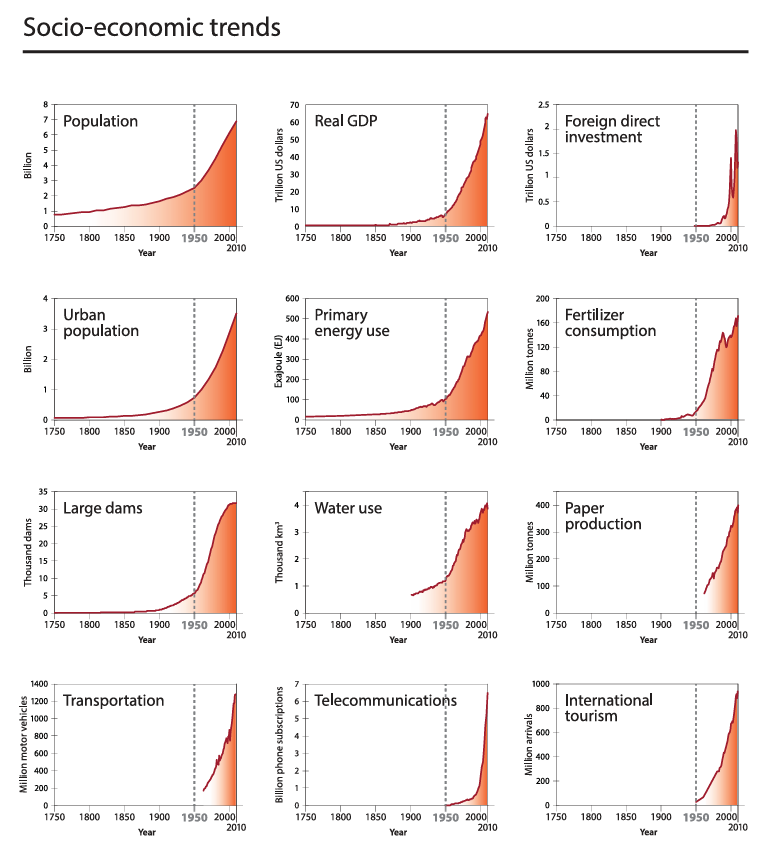
Figure 0.1. The Great Acceleration. Socioeconomic trends. In Will Steffen et al. (2015), “The Trajectory of the Anthropocene: The Great Acceleration,” Anthropocene Review 2 (1): 81–98. With permission from Sage Publications.
Beginning around 2004, geophysical evidence of this expansion’s impact on Earth’s systems consolidated, and its multiple drivers were grouped together under the label of the “Great Acceleration.” However, the scientists assembling this research suggested a different transition point: the mid-twentieth century. The now-familiar “Great Acceleration graphs” illustrate this shift, showing dramatic upswings around 1950 across a wide range of indicators—from rising atmospheric carbon dioxide concentration and surface temperature to the interruption of the hydrological cycle through large dam construction. And what was the first socioeconomic driver documented by this group of human, natural, and Earth scientists? Accelerating human population growth (Fig. 0.1).
In 2009, an Anthropocene Working Group (AWG) was established by the International Commission on Stratigraphy (ICS). In 2023, the working group assessed evidence that the Holocene epoch—essentially the last 12,000 years of relatively stable climate—had been succeeded by the Anthropocene, dated by them from 1952. This scientific proposal was later, amid controversy, rejected. For our purposes, it is important to note that the AWG also foregrounded population: “Its beginning would be optimally placed in the mid-20th century,” the group proposed, as a result of “‘the Great Acceleration’ of population growth, industrialization and globalization” (AWG 2023). Key members of the Anthropocene Working Group—now an independent body—contribute to our discussion here.
There’s no question that the modern expansion of human population is historically unprecedented, whether we consider ca. 1800 or ca. 1950 as the moment of surging human impact on the Earth (Fig. 0.2). And so it might seem obvious or even unremarkable that experts who have nominated and substantiated “the Anthropocene” and “the Great Acceleration” have included human population growth in their analysis. Yet across the social and human sciences, the entire domain of “population”—politics, policy, praxis, economy, epistemology, geography, ontology—sits with palpable unease. But why, and with what effect? How do we think about population in the Anthropocene? More normatively, how should we, or how might we? Indeed, should we forgo the early traditions of Anthropocene scholarship and abandon population talk altogether? What do we do with the biomass of (differently) consuming humans in the epoch we’re so keen to name after us? And do we think that population is, or should only be, about humans?
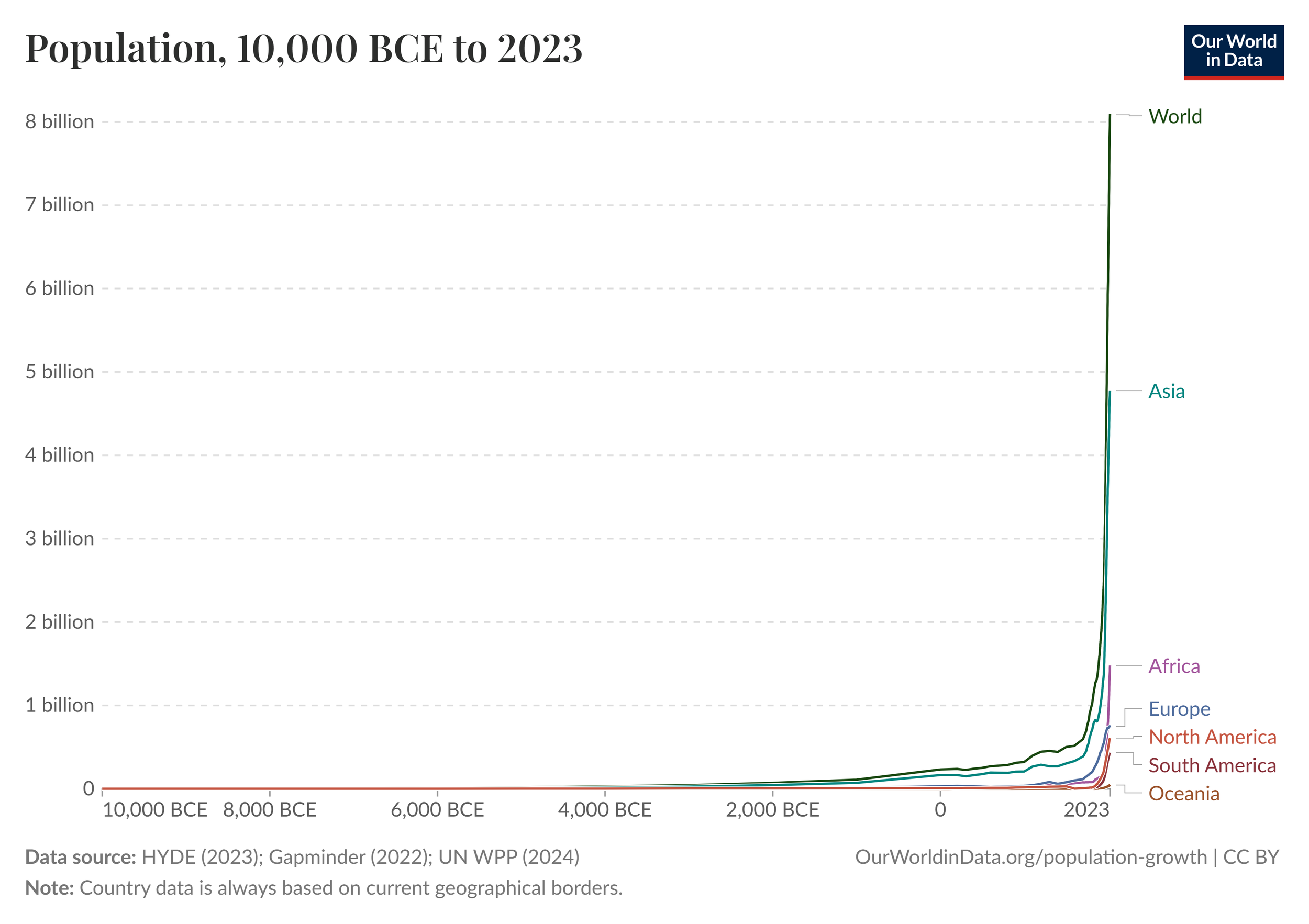
Figure 0.2. World population growth over the Holocene and Anthropocene. Source: Our World in Data, https://ourworldindata.org/grapher/population.
One answer to the question “How do we think about population in the Anthropocene?” is: more carefully, because of Adele Clarke and Donna Haraway’s Making Kin Not Population: Reconceiving Generations (Prickly Paradigm Press, 2018). Self-billed as ending a silence, these scholars brought ambitions for environmental justice, reproductive justice, and multispecies justice together, a joining constructed from considerable disagreement. In this particular intellectual joinery, ideas are not so much aligned as angled, like a right-angled butt joint or an elegant dovetail that, in the end, provides strength and structure. It is a collection that looks beyond. Michelle Murphy is “Against Population” and “Towards Alterlife”; Kim TallBear looks “Beyond Settler Sex and Family”; Ruha Benjamin insists that “Black AfterLives Matter.” “Population” is so tightly bound to coercive, racialized policies and practices, especially on and about women of the Global South, that it can seem that the only way forward is to abandon population talk altogether. And yet, a bit like Foucault’s early observation that an apparent silence on sexuality manifested very loudly, this critique is resounding and generative, a massive feminist and decolonial intervention into our understanding of modern life, birth, death, power, sex, and race, and increasingly considered in the context of climate change (Hendrixson et al. 2020; Sasser 2018; De Luca Zuria 2024; Sebastian 2026).
It’s disingenuous, really, to claim that there has ever been a silence or even (after Coole 2021) a “toxification” of population discourse. A link between human population dynamics, climate change, and the Anthropocene is debated regularly enough: in formal statements from the United Nations Population Fund; among economists and demographers; from analysts of the energy sector; and by health and food experts. Some researchers and commentators don’t bother to consider the obviously sexed, gendered, racialized, and embodied implications of discussing “population,” as if it were disconnected from reproduction or from a well-problematized history of population control. The proponents of “a dynamic integrated climate-economy-demographymodel,” for example, posit that “population policy may represent an effective mitigation tool to complement standard climate policies” (Lupi and Marsiglio 2021, 1).
Given the history of demographic policy, why wouldn’t we be alarmed? More commonly, however, there is recognition and incorporation of the difficult history of population policies. A Swedish American team of biological and environmental scientists, for example, is convinced that human population growth is a threat multiplier. At the same time, these scholars emphasize that any response must involve what they describe as “rights-based policy interventions” and “humane policies.” As part of this multifaceted strategy, they note that “low population pathways would contribute to emission reductions and minimize climate risk” (Dodson et al. 2020, 1).
However we think population should be addressed in climate change and Anthropocene discussions, there is no question that it already is, all the time, and in a multitude of ways.
In this volume, we ask experts in Anthropocene studies—humanists and scientists—whether and how human and other-than-human populations figure in accounts of planetary change. Several members of the now independent and active Anthropocene Working Group respond.
Geologist and historian of science Naomi Oreskes acknowledges that for many years, she sidestepped questions of population, and even as she became more attuned to the effects of global climate change, did not see population growth as a primary variable. Oreskes recounts how her thinking began to change when she moved beyond climate change to consider the broader suite of problems associated with the Anthropocene, such as habitat destruction and biodiversity loss. Here, the primary driver is human encroachment, and while Oreskes is clear that the picture is complex, she is also confident that the education of women—and wider female empowerment—would decrease global growth and decelerate species extinction and habitat loss.
According to geologist and paleontologist Jan Zalasiewicz and historian Julia Adeney Thomas, the most pressing effect of population growth on the Earth is the rise of a “technosphere,” or the combined material output of all human creations. A recent estimate concluded that anthropogenic mass now exceeds the combined weight of all living matter (Elhacham et al. 2020), and there is compelling evidence to suggest that this imbalance is affecting the replenishing powers of Earth’s subsystems, leading to significant problems such as species extinction and global climate change, to name only a few.
J. R. McNeill offers the perspective of an environmental historian, a cadre of scholars who are, on the whole, reluctant to attach much significance to population. For McNeill, this reluctance stems partly from the absence of reliable long-term population data and partly from the complexity of the term “environment.”
Beyond the Anthropocene Working Group, transnational historian Matthew Connelly argues that population discourse in the Anthropocene is marked by a striking amnesia about the past, particularly the fraught population politics of the twentieth century. Connelly further contends that population decline—now underway in more than sixty countries—does not automatically lead to reduced environmental harm. On the contrary, societies with fewer children and ageing populations often consume more resources, especially those societies “composed of small nuclear families, couples, and people living alone.” For Connelly, this means that environmental politics cannot (and should not) be reduced to demographic arithmetic, but must instead confront patterns of consumption, inequality, and social organization.
Science writer Meehan Crist tackles the thorny question of whether reproductive justice can be reconciled with environmental justice. In other words, is it okay to have a kid in the Anthropocene? For Crist, “win-win” policies that aim to lower fertility, reduce emissions, and lessen environmental burdens often end up pathologizing the bodies of women in the Global South. This process risks turning deep structural inequalities into environmental necessity. For Crist, there are no easy answers, no silver bullets, no “win-wins.”
Degrowth scholar and economic historian Matthias Schmelzer argues that population in the Anthropocene can be understood only when situated in a broader political economy of economic growth. For Schmelzer, planetary destabilization is the predictable outcome of a capitalist system dependent on unbridled growth. Schmelzer is not advocating that we ignore population; there is a need, he says, for an emancipatory approach to social and biological reproduction, one that adheres to principles of collective self-limitation and democratic autonomy.
In his chapter, historical geographer David Nally shifts our focus from the politics of human populations to the politics of livestock populations. Today, there are more than 8.3 billion humans on the planet, but this number is dwarfed by 85 billion livestock animals raised and slaughtered annually for human consumption. According to Nally, alternatives to carnivorous capitalism and its deadly diets point less toward population control than toward building food systems that are ecologically regenerative and organized around collective well-being.
Through the historical thought experiment of “three Anthropocene generations,” global historian of science Alison Bashford tracks the dis/connections between the infamous “population bomb” first generation, those second-generation Anthropocenes who offered a massively successful critique of population control, and the third-generation beneficiaries of that critique in the planetary now. Yet Bashford also asks: Is there a reasonable or useful postcritique regarding population in the Anthropocene?
Gender and science scholar R. Sánchez-Rivera offers an instance of the marginalization of the Global South in her history of population control in Puerto Rico. Following the recent expansion of reproductive justice approaches to consider environmental reproductive justice, Sánchez-Rivera shows how the colonial long history of the Anthropocene must be incorporated into current analyses.
Public health historian Kavita Sivaramakrishnan examines another great change in human population across the world’s polities: ageing. With a focus on Asian experts, she examines demographic and policy responses to the ageing/climate change dyad. Are tropes about older people’s incapacity to adapt, sluggish responses to mitigation policies, and thoughtless consumption of carbon-emitting products valid? Just how has the growing proportion of the global elderly been situated within climate-change policy, scholarship, and practice?
In this context, political theorist Duncan Kelly wonders whether population politics is not only toxic, but has become the basic frame for political thinking in the Anthropocene. Pushing a thought originally found in Making Kin Not Population, he tries to think about whether, in the attempt to salvage Anthropocene complexity from its critics in the social and human sciences, what has in fact been reinstated as the principal political focus of nation-states dealing with climate change in the Anthropocene is precisely a sense that politics means population.
Collectively, these essays invite us to rethink population in the “Age of Humans.” For some contributors, the central concern is whether human populations continue to extract and burn large quantities of fossil fuels, intensifying ecological breakdown and accelerating climate change. Other accounts decenter human population numbers altogether, directing attention instead to historically specific modes of socioeconomic organization. From this perspective, ecological impacts are shaped not simply by how many people there are, but by how they choose to live. In this book, we have emphasized, for example, uneven dietary regimes in which affluent communities consume vast quantities of animal protein; infrastructures that enable (some) populations to enjoy energy-intensive lifestyles; demographic formations in which ageing societies may not consume at the same pace, or in the same way, as younger, expanding ones; and material systems that leave residues that endure in (some) bodies and environments—from microplastics and “forever chemicals” to neonicotinoid insecticides —and that now accumulate at stratigraphicallysignificant levels. “Population,” in short, emerges not as a biological given, but as a differentiated and politically mediated assemblage of practices, capacities, and behaviors.
Where does this leave us today? While Darwin asked us to consider humans as a “species” (embedded in evolutionary time and shaped by natural selection) and Malthus urged us to understand humans as a “population” (governed by fertility and mortality and constrained by finite resources), the Anthropocene reveals a far more complex and unsettling picture. Humanity appears not only as a species or population, but as a geophysical force, capable of altering atmospheric chemistry, oceanic systems, and biogeochemical cycles.
And yet humanity does not act as a coherent biological unit confronting pregiven limits. The capacity to transform—and to destabilize—the planet is of course unevenly distributed and historically produced. Moreover, we share this planet with many other species, each with its own evolutionary history and ecological roles that are, at the same time, increasingly entangled with human populations and their anthropogenic environments. We are thus compelled to imagine a world in which species collide and populations intersect, where limits are pressing and urgent, but at the same time contingent on history, power, and politics. Above all, as this book has sought to emphasize, we must resist reductive narratives that cast “humanity” as a homogeneous force—either as Homo deus, triumphant and godlike in its technical mastery, or as Homo miserabilis, destined to collapse under the weight of its own excess and hubris. Instead, it seems to us more helpful and hopeful to foreground differentiation—between regions, social groups, and lifeways—and call for more nuanced accounts of vulnerability, responsibility, and possibility in the Anthropocene.