A Broken Mirror for Princes? (What if) Population is the Anthropocene?
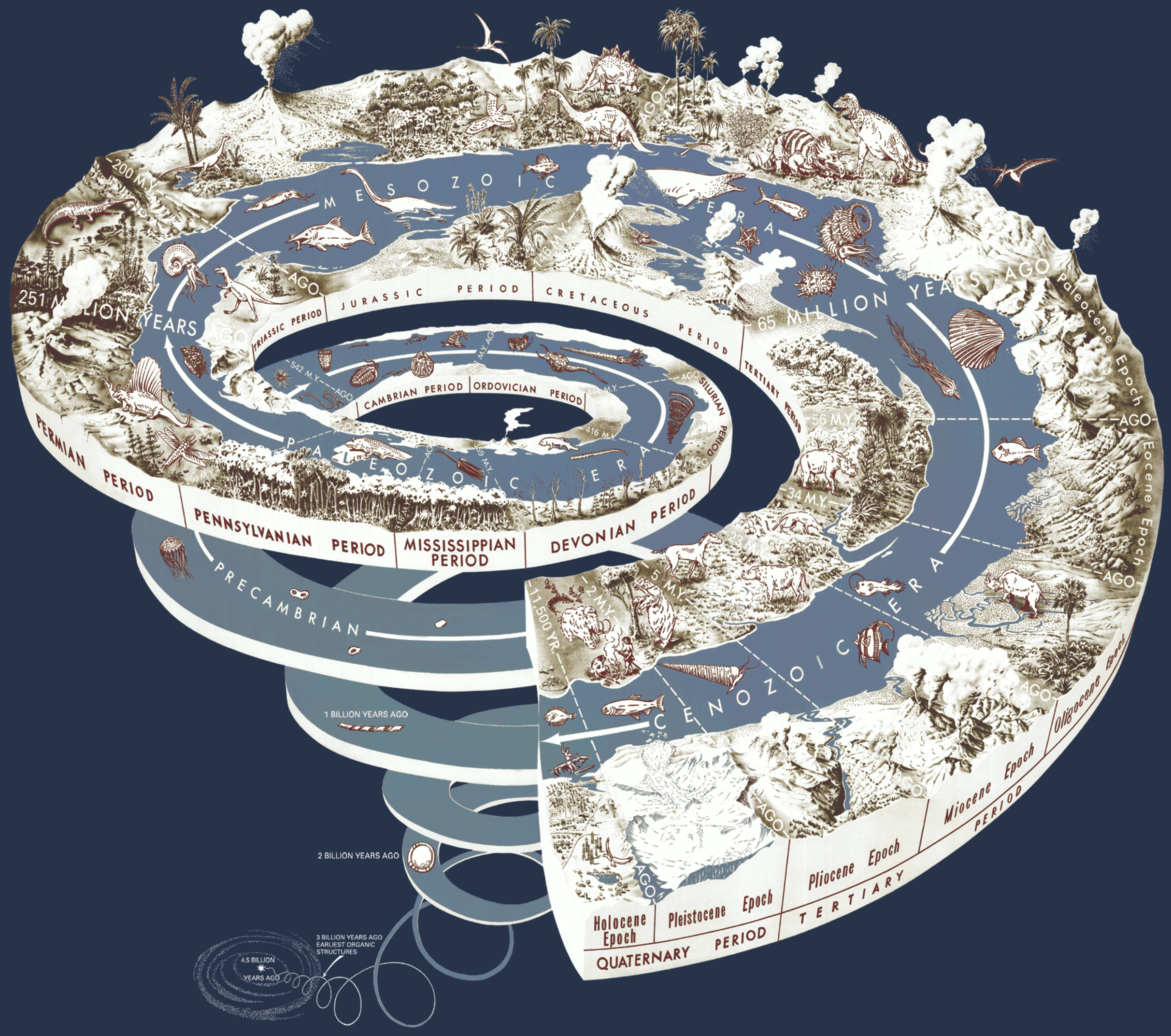
Geological Time Spiral, United States Geological Survey, Public domain, via Wikimedia Commons
Over a decade ago, Alison Bashford wrote that modern history, particularly modern Australian history, is the Anthropocene. This, because it mixes deep time, indigeneity, and settler colonialism, carbon and megacontinental histories (Gondwanaland), with the continual ebb and flow of big-picture population politics between the extremes of pronatalism and eugenics, laissez-faire or statist management. Shortly afterward, Jedediah Purdy, too, declared that modern America is the Anthropocene, in that the racialized contours and concepts of its environmental politics, as well as the connections between deep time, indigeneity, and settler colonialism, were made American, culminating perhaps in the figure and politics of Teddy Roosevelt, but they were already of the Anthropocene. As Caroline Winterer has more recently put it, America as the “New World” became old in the nineteenth century, in part through the confrontation of deep time with modern politics and history (Bashford 2013; Purdy 2015; Winterer 2023).
The same might well be said in reverse for the numerous debates between those who see the realities of the Anthropocene as embodying a new geological epoch, and those who prefer to decenter the idea of an epochal shift and focus on transitions, instead of ruptures. Here, the Anthropocene just is (and for many climate scientists, always has been) a problem of population. While the Anthropocene Working Group voted almost unanimously to propose a Holocene–Anthropocene transition, identifying a “golden spike” in the sedimentary layers and mixed chronostratigraphic traces dating from 1952 in Crawford Lake, Ontario, the Subcommission on Quaternary Stratigraphy, speaking for the International Commission on Stratigraphy, rejected the claim. Yet the Anthropocene remains vivid for many concerned to signal the intensification of boundary positions around the geological agency of human populations (Gibbard et al. 2022).
For those who think of the Anthropocene as an intensification of political boundaries around population, too, there tends to be a focus on interweaving histories of capitalism and extraction, colonialism and exploitation, imperialism and plantation, to set against models of kinship and interpersonal (even multispecies) entanglements. Here, I think a combined set of responses has structured those interested in political thought and the Anthropocene. On the one side, there has been a move from thinking about population between human generations to a concern with population within and between species and the exponential threat levels of what Elizabeth Kolbert (2014) terms an emerging age of a “sixth extinction” through the interactions between those two levels. On the other, there has been an attempt to explore the shape of that transition by trying to view worldly politics from a planetary perspective, a perspective forced upon human beings by their “stumbling” from the political economy of “globalization” into the planetary sphere of the Anthropocene (Chakrabarty 2021). All might agree that the historical trajectory of human population growth spiked in the post–World War II period as the “Great Acceleration,” but many see the shift in different ways, generating different forms of critique (as shown in the chapters here by Oreskes and Bashford). It can either point forward to ever-greater numbers (and therefore energy-relevant) concerns (as McNeill, Connelly, and Schmelzer emphasize here in different ways), or backward, to questions of reproduction, fertility, and demographic decline (as shown in the discussions by Crist, Sivaramakrishnan, and Sánchez-Rivera). The latter critique, in particular, forms a sort of refracted consequence of the long-run experiences (often catastrophic) of what Alfred W. Crosby (1986) termed “ecological imperialism” and its effects on local populations.
That there will be a point at which both current population increase and demographic decline intersect, however, turns that moment into a political question that has attracted much recent attention. Today, concerns over the total fertility rate and the fact that so few countries have a reliable replacement rate of 2.1 or above hold a mirror up to politics as being governed by essentially binary choices about how best to act. Where and how boundaries might be seen along this axis of convergence serves to intensify the political stakes involved. It has led many to one overarching question about human futures, namely, how can the global population reproduce itself once this “spike” point has been passed? (Spears and Geruso 2025; Sciubba 2026; Runciman 2025; cf. Szreter 1993 and 2025).
Whether that concern relates to those boundaries delineating safe or uncertain “operating spaces” for humanity, boundaries in the overlapping connections between ecological biomass and a systemic technosphere, or boundaries of overlapping temporalities and differentiated responsibilities in terms of global histories, one point seems to connect them all. Population. And my thought here, necessarily compressed and highly staccato, is that as much as modern history and modern politics can be the Anthropocene, that is also just to say that population politics is or has often seemed to become the underlying political theory of the Anthropocene. If it is, what that tells us about is that the Anthropocene has become a sort of broken “mirror for princes” genre in certain quarters of contemporary politics whose principal orientation turns on providing a seemingly ready and realist guide to population questions for policymakers and politicians as the decisive issue in dealing with complex challenges of catastrophic climate change. The oft-imposed binary choice between variants of utilitarianism, neo-Malthusianism, or pronatalist nationalism suggests as much, even though critics (particularly feminist critics) have done much to illustrate just how much more complex a focus on reproduction and population politics is. But in much mainstream political discourse, population politics is the Anthropocene, both for those seeking simplification and binaries as a way of seeing politics clearly, as well as those seeking complexity and boundaries and who think that Anthropocene clarity is a mirage, both at the level of substantive interest, but also at the level of language. It is, one might say, a mirror crack’d.
In their essay “Is It OK to Have a Child?” Meehan Crist (2020) writes,
having a child is at once the most intimate, irrational thing a person can do, prompted by desires so deep we hardly know where to look for their wellsprings, and an unavoidably political act that increasingly requires one to confront not only the complex biopolitics of pregnancy and birth, but also the intersecting legacies of colonialism, racism and patriarchy, all while trying to wrap one’s head around the relationship between the impossible extremes of the personal and the global.
The fact that population politics is also a gendered politics around the site of female bodies where the process of reproduction principally takes place also signals another way in which the overlapping dynamics of the Anthropocene reflect the turbid ebb and flow of the performativity of gender politics.
Population across time and space, between generations, the intimate and the structural, past and future, is irrevocably interconnected. And in this way, population politics seems here to be the mirror for a human-centered political theory of the Anthropocene that is concerned with climate change and politics as they currently exist. It becomes a question of what exactly we think about when we think about “growth” and limits, about transfer rates, and about the possibility of human depopulation. But if population (and possible depopulation) is the Anthropocene in terms of its mixing of structure and agency, bewildering temporalities, legacies of exclusion and extraction alongside contemporary distributional inequalities and (for some) a catastrophism that renders it politically nugatory, should we really want to keep either term? (Nordblad 2021).
This, I think, is part of the conclusion (perhaps also the motivation) behind the seminal work of both Donna Haraway and Marilyn Strathern, focusing on the importance of kin and of kin making between species, rather than population (Clarke and Haraway 2018; Strathern and Sasser 2019, 159–72). They help to provide an entangled alternative to the pursuit of the political management of populations, looking instead to the messy boundaries where politics and kin making might alternatively take place in what Haraway has suggestively called the Chthulucene, as opposed to the Anthropocene. The language here is also crucial; as Haraway has worked so hard to show, the terms of art in these debates lock you into certain ways of seeing and knowing, and her own writing seems to be an attempt to authorize a new kind of politics by trying to avoid the logics of contemporary locutions. Critics often attack it for being opaque and amplify their critique of the Anthropocene to claim it is a flight from the economic realities behind the contemporary ecological crisis. Still others argue the Anthropocene manifests as another high-modernist attempt to “see” politics through planning, management, and control. The “good” modernist Anthropocene with green growth, for instance, seems to fit that model, or mode, while other forms of nationalist and pronatalist politics could fit the other. Instead, making kin might just avoid conflating population (and therefore politics) with the Anthropocene in the first place and take us to a place where boundary politics can be differently conceived. The parallax view, outlined by Dipesh Chakrabarty, where this one planet contains many divergent worlds within it, suggests the impossibility of retaining any singular account of the “political” in which population politics (among other things) can be kept in check without first transforming it into something more explicitly ecological so as to take account of the geological agency and impact of human life upon the planet (Chakrabarty 2023; cf. Mann 2024; also Bashford 2014; Connelly 2008).
By contrast, in coverage by The New York Times of the seeming “demographic dividend” now available to India, for example, by virtue of its more rapidly growing population than China, even with broad demographic decline, the geopolitical and geoeconomic valences remain very conventional forms of population politics. Rising population, rampant (even if potentially motivational) inequalities, exclusionary political leadership and religious divisions, continued border conflicts with Pakistan over Kashmir particularly, and the possibility of mobilizing highly skilled labor in the fields of service and technology provision, as well as more traditional forms of industry and resource extraction, suggest the possibility of economic growth along new paths, emulating neither the Chinese nor the Anglo-European “models,” but winning, in a very old-fashioned way through population.
Here, population is a resource, a demographic driver of growth, whose analysis is connected to long-standing questions in political economy dating back at least to “classical” discussions by Adam Smith and David Hume, among others, of the relationships between population growth and the transition from the ancient world to modern commercial societies, as well as between the capacity for cheap labor to undercut the predominance of European models of politics and economics grounded in emulation and empire. While that was one eighteenth-century worry about China from the perspective of Scotland, now it is a commonplace that, in the words of another New York Times piece, “shrinking populations fuel divisive politics” (Mashal and Travelli 2023; see also Taub and Leatherby 2024. Cf. Arrighi 2009). Precisely this conception of population as resource and driver of growth, alongside the twin challenges of population growth relative to offsetting increased carbon emissions and a demographic transition currently in place where the rate of replacement is in precipitous decline across many parts of the world, suggests another problem space where population looks like it just is the Anthropocene. Divergent dilemmas seem to throw up binary options (reduce numbers, at the same time reduce emissions and energy use) and generate technological fixes for climate seen as an engineering problem, prompted by the presumption of a political economy of medium-long-term convergence.
My own previous attempt to consider debates in the history of political thought about human population futures offered a brief conceptual history of the problematic lineages and metaphors around limits to growth—the population “bomb,” famine, and the putative solutions in forms of “lifeboats,” planetary visions of “Spaceship Earth,” from the 1960s onward. It pointed out some of the weird combinations of, say, Bay Area communalism and experimentalism with racialized presumptions baked into much of its discussion of population geared around the “quality of life.” Or more bluntly, which sorts of lives are deemed of value or grievable in a world of relentless warfare and “cannibal capitalism” (cf. Butler 2016; Fraser 2023). All such attempts provided new languages or metaphors for seeing the population problem.
Now, though, following Diana Coole, we can see how population in political theory has often been a submerged narrative, as if the subject were too toxic to be explicit about. Coole (2013, 196) notes the myriad discursive strategies of avoiding population talk. These range from “shaming” (where discussion struggles to move beyond entrenched epistemological limitations fostered by unequal legacies and relations of colonial exploitation and racism); to “scepticism” (where demographic transition theory prompts doubt about headline claims of rising population); “declinism” (which builds on that doubt to claim that populations are actually lowering, but focuses only on the short run); “decomposing” (that is, referring not to aggregate levels of population and welfare as “other-regarding,” but instead seeing population as a self-regarding activity to do with choice and individual liberty); and “fatalism” (suggesting that it’s not something that can readily be factored into debates about climate change and the Anthropocene). Obviously, attempts to discuss population control and regulation across the so-called Global North and the so-called Global South play very differently depending upon where you start from. So, too, does it matter how you think about utilitarianism, the “mere addition” of persons and questions of welfare, and the (soritical) logic that writers on population ethics such as Derek Parfit and Jan Narveson developed and that others, such as John Broome, have advanced in different ways toward thinking about a “global commons” (Kelly 2019, ch. 5).
As political theorists such as Brian Barry had also noted when discussing these issues during the 1970s, if one starts to ask questions about politics and population between human generations with environmental considerations front and center, conventional social contract models of political theorizing quickly run up against their conceptual limitations. Equally, while moving toward the “trouble” of kin making with Haraway might push us in another direction, we still lack a conventional language for theorizing population entanglements, whatever we take the “circumstances of justice” to be (Barry 1978, 204–48).
And that is precisely the point. If population ethics and mainstream population politics just are how conventional philosophy and politics respond to and render legible the Anthropocene, then perhaps what they are providing is a broken “mirror for princes” model about how population problems might be dealt with. This, particularly when myriad human populations instead find themselves in various degrees of exhaustion through worldly forms of politics that have front-loaded climate effects onto those often least able to shield themselves from them (Chaudhary 2024). The turn to kin making at least recognizes the potential of the Anthropocene to provoke more from political theory than its traditional modes and models, but a truly entangled vision that combines radical localism with what others have called for as a planetary consciousness, grounded in the basic right to breathe, might need a different sort of conceptual language again (Mbembe 2019, 2022, 7–41). Finding new languages for this predicament veers wildly from the uncanny and sublime to the earthy and the microbial. It requires us (as chapters here by Nally and Zalasiewicz and Adeney Thomas note) to think more expansively about what exactly we mean when we look to interpret population beyond the merely human and to think about both technospheres in tandem with biomass and meatification, for example. Equally, as historians continue to teach us more about how certain “transitions” (around energy, around population) were always really about just using more, and more, and more, and about how far mainstream conceptions of freedom in modern political theory are bound up with increased energy use and ecological overreach, how we think about population in the Anthropocene suggests a need for some quite radical conceptual development in political theory (Charbonnier 2021, 85, 90, 246; cf. Fressoz 2024). In seeking to be both worldly and planetary, political theory might need to learn how to grieve for an old-world politics of “population” already lost and find hope (as well as new languages) in forms of future politics still waiting to be born (Lear 2006; 2022, esp. 62–64).